
While planning my trip to Egypt, I desperately wanted to visit the temples of Dendera and Abydos. They seemed like the kind of places that would make you feel less like a tourist and more like an explorer.
But once we were actually in Egypt – DIY trip with no guides, no tour operators – my partner and I ran into a very big problem – cabs.
Finding honest cab drivers in Egypt is not easy. Most quote steep tourist prices, and when you combine that with constantly having to dodge touts and scams, it gets exhausting very fast.
By this point in our trip, we were honestly pretty fed up with Luxor and how it treats tourists. We were tired of haggling with drivers who kept quoting ridiculous amounts for day trips. After messaging countless drivers on WhatsApp and getting nowhere, we eventually gave up on Abydos entirely and decided to only go to Dendera.
The thought of being stuck in a car all day with a driver who I knew was already overcharging me – and then still having to pay baksheesh at the end – was enough to make me seriously consider just staying at the hotel.
Luxor has that effect on you.
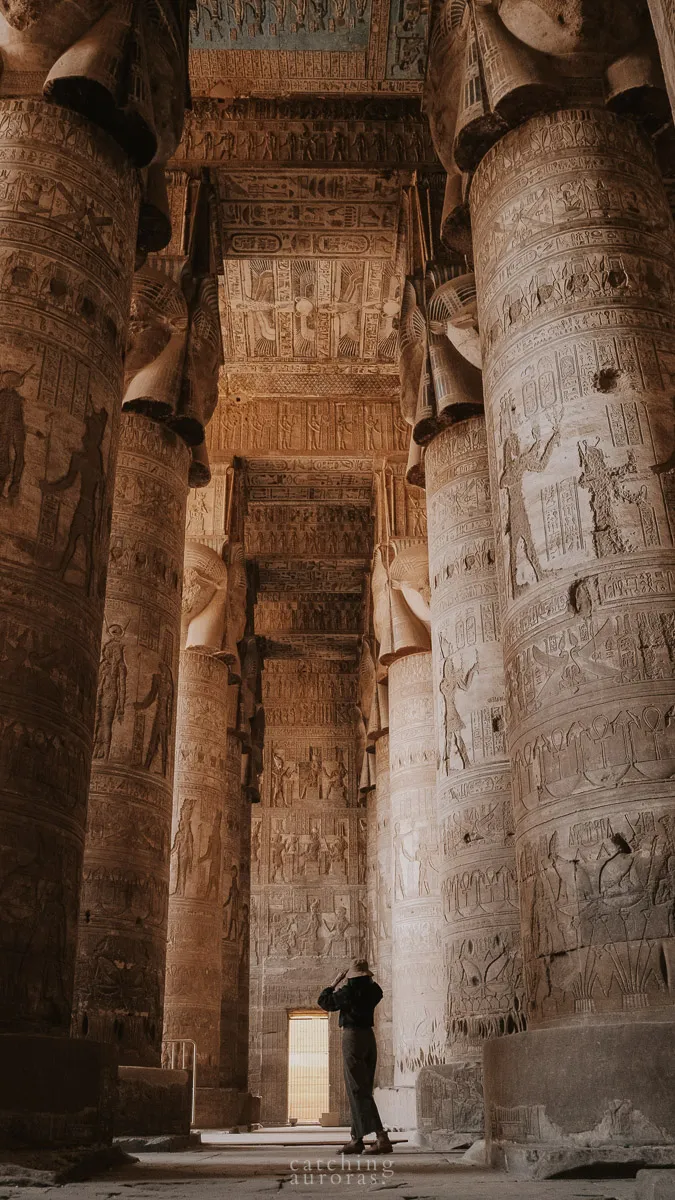
Anyway, after a lot of negotiations, we eventually found a driver willing to take us to Dendera and back early in the morning. We left Luxor at 6 AM, reached Dendera by 7, spent about two hours inside, and were back at our hotel by 10. And yes, we still gave the driver his baksheesh.
So the big question is: was all that hassle actually worth it?
Where Is Dendera Temple Located?
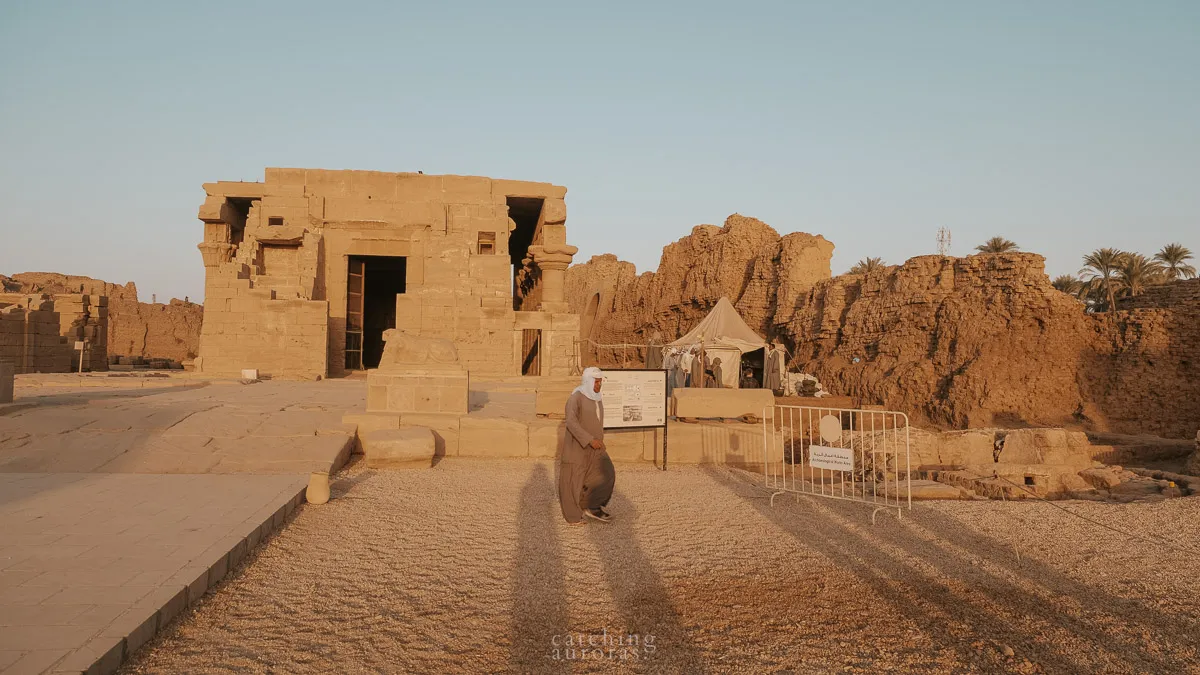
Dendera is an ancient city in the Qena Governorate, about 70 km north of Luxor. It sits on the west bank of the Nile and is considered one of the best-preserved temple complexes in Upper Egypt.
Quick note on the geography: despite the name, Upper Egypt is in the south of the country. The Nile flows from south to north, so the upstream regions get called “Upper” – which confused me the first time I looked at a map.

What Is Dendera Temple Egypt Famous For?
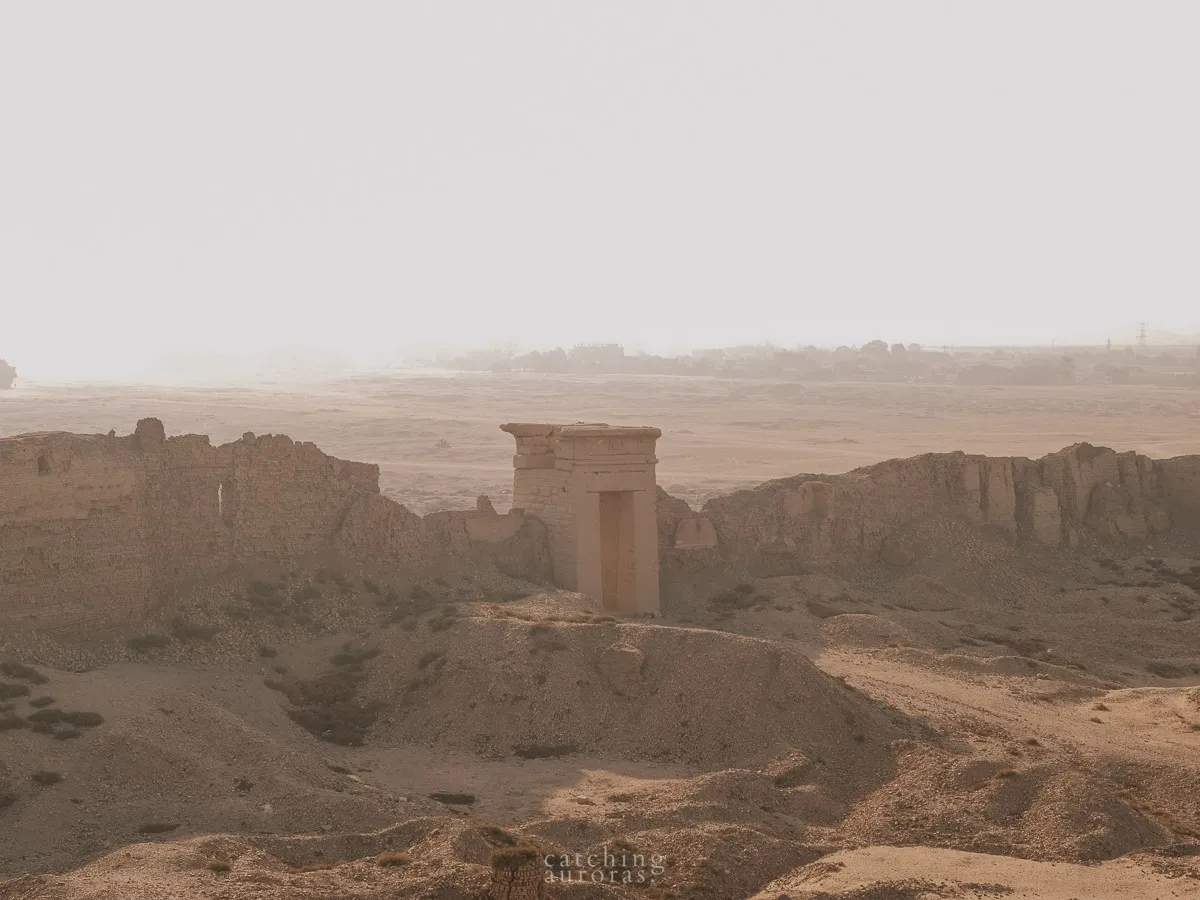
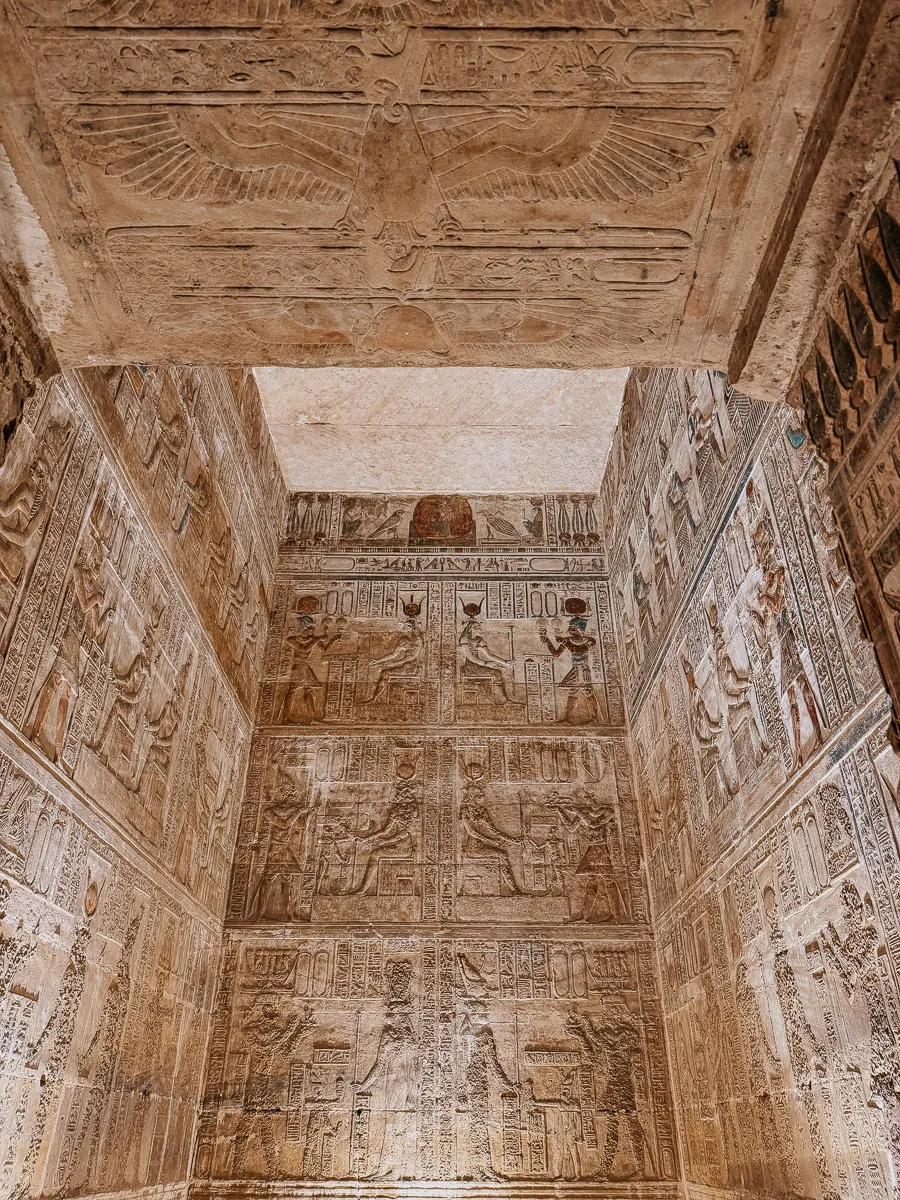
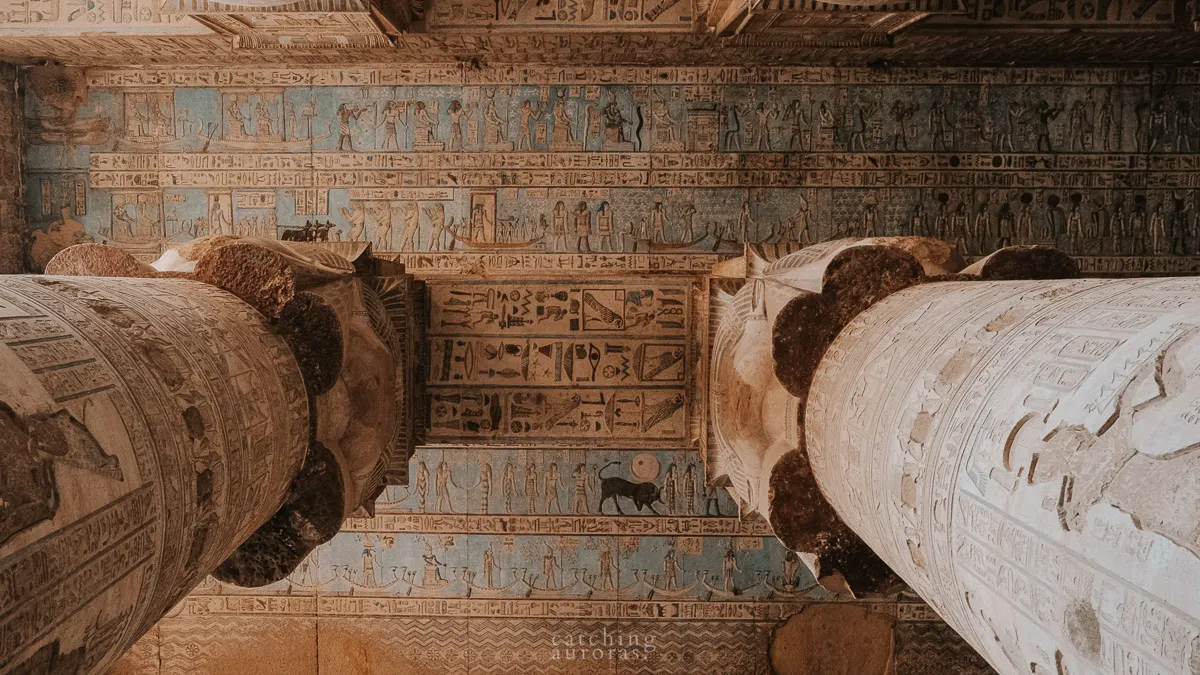
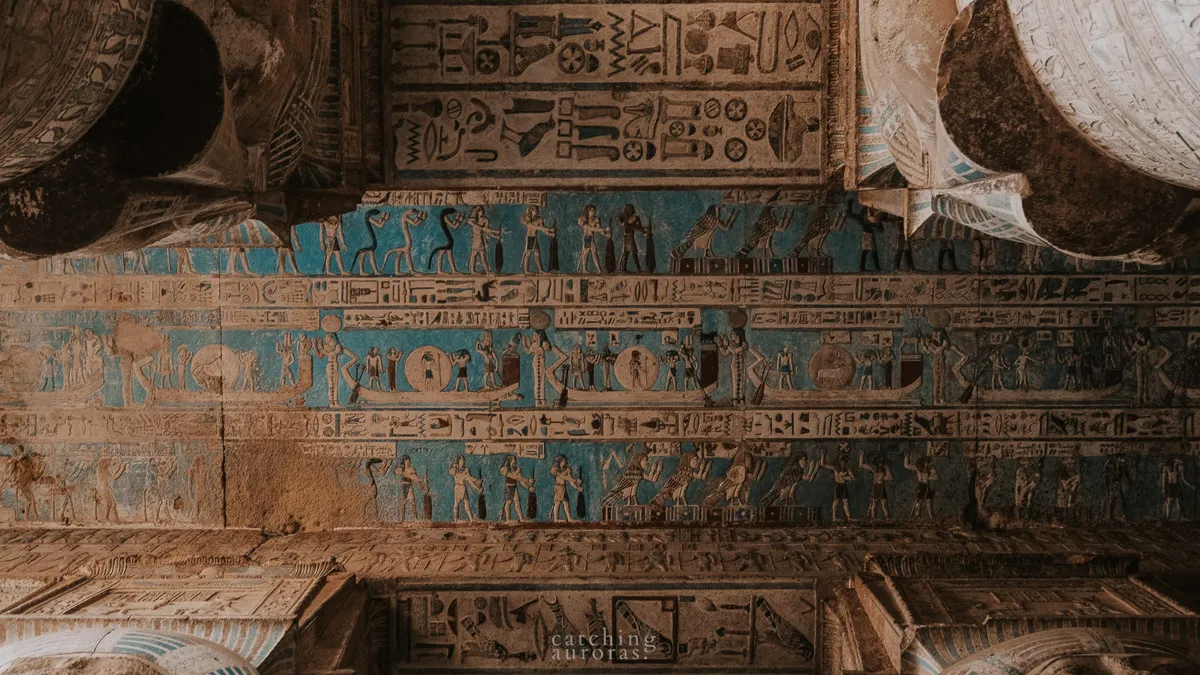
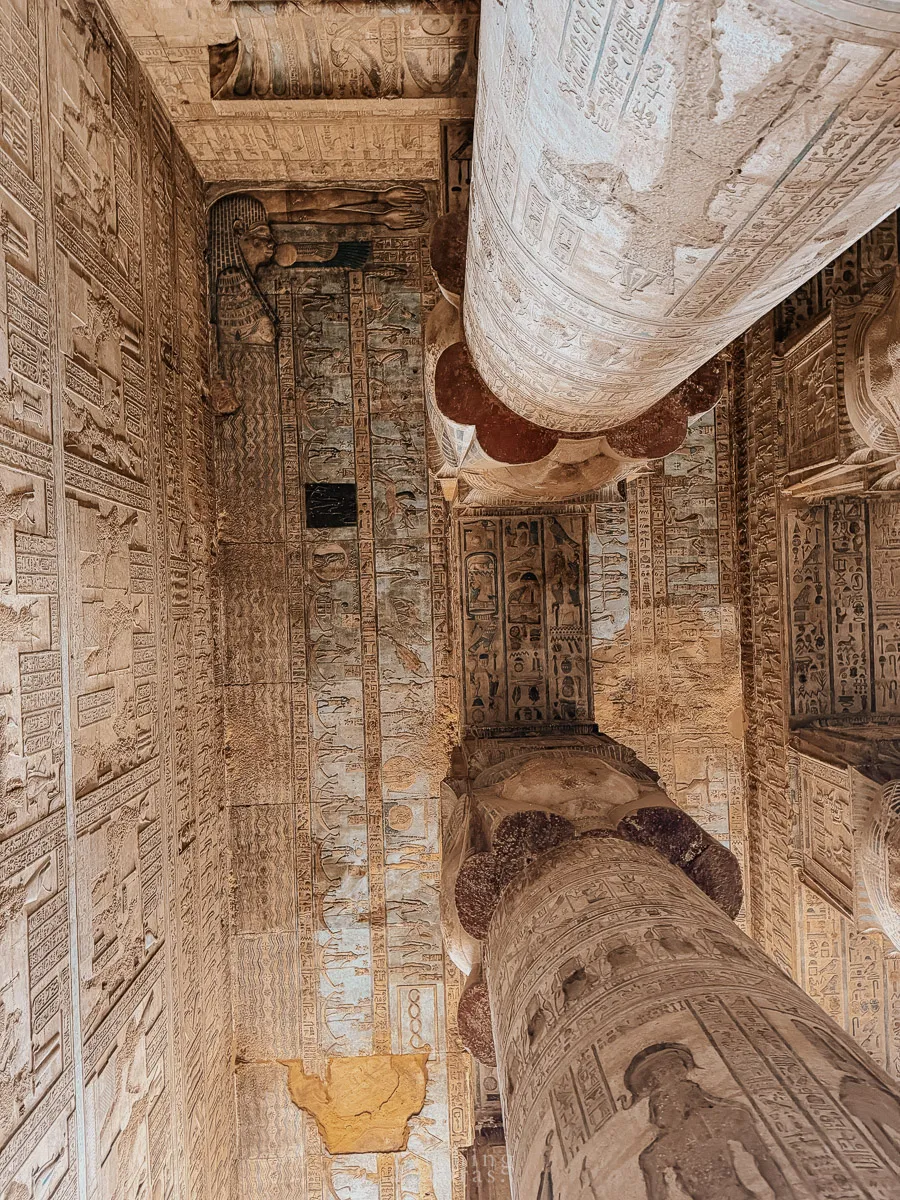
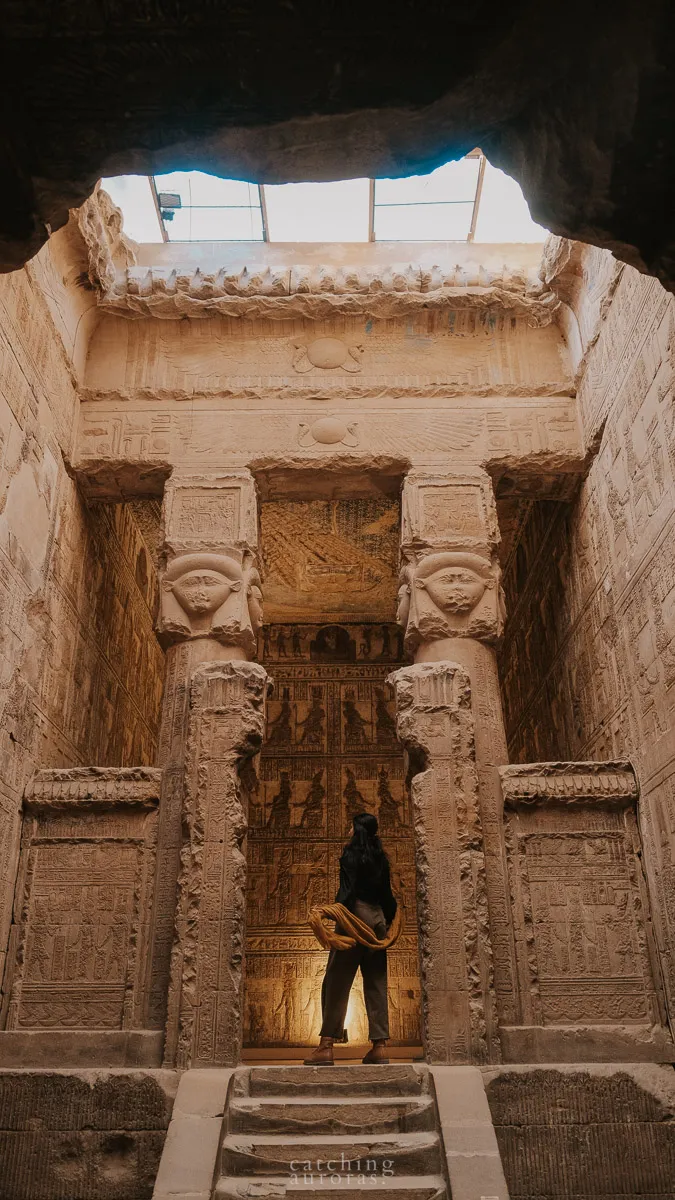
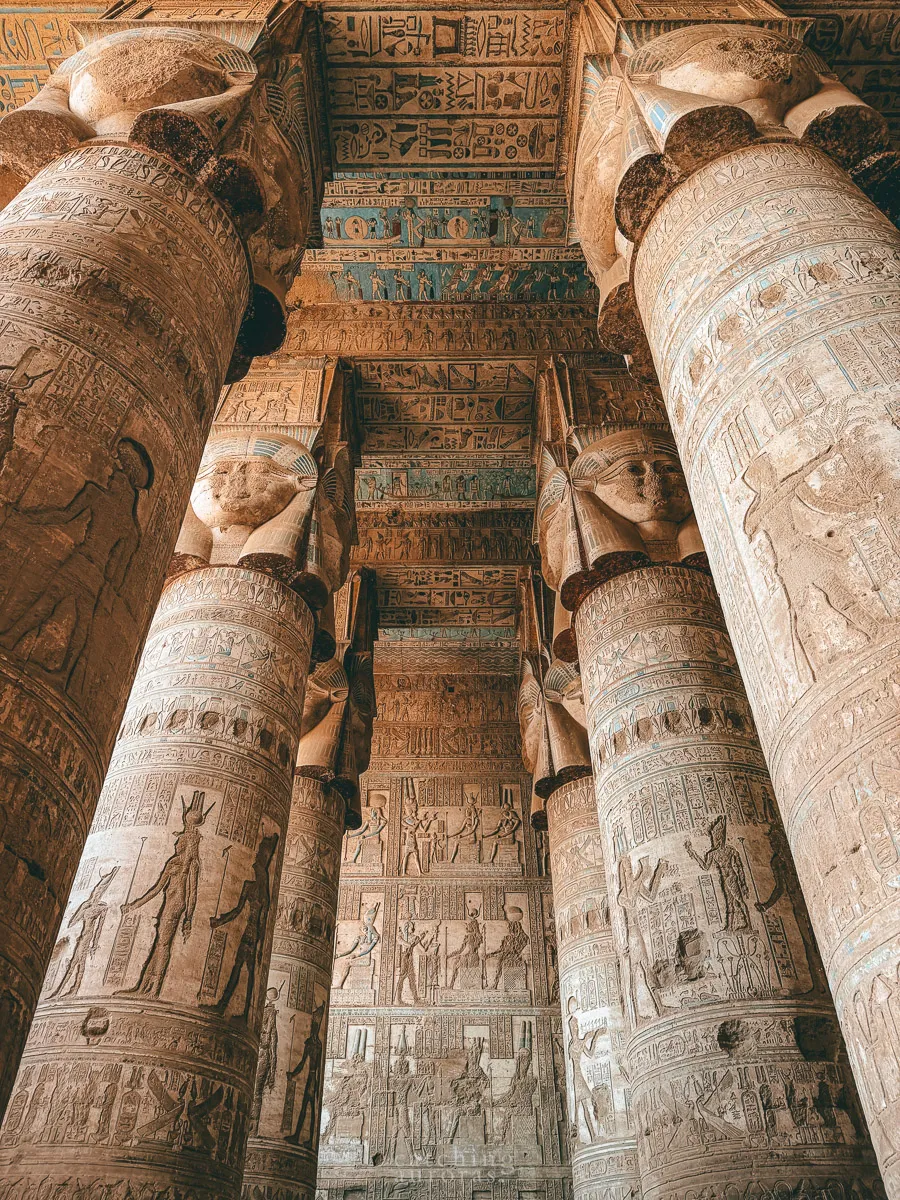
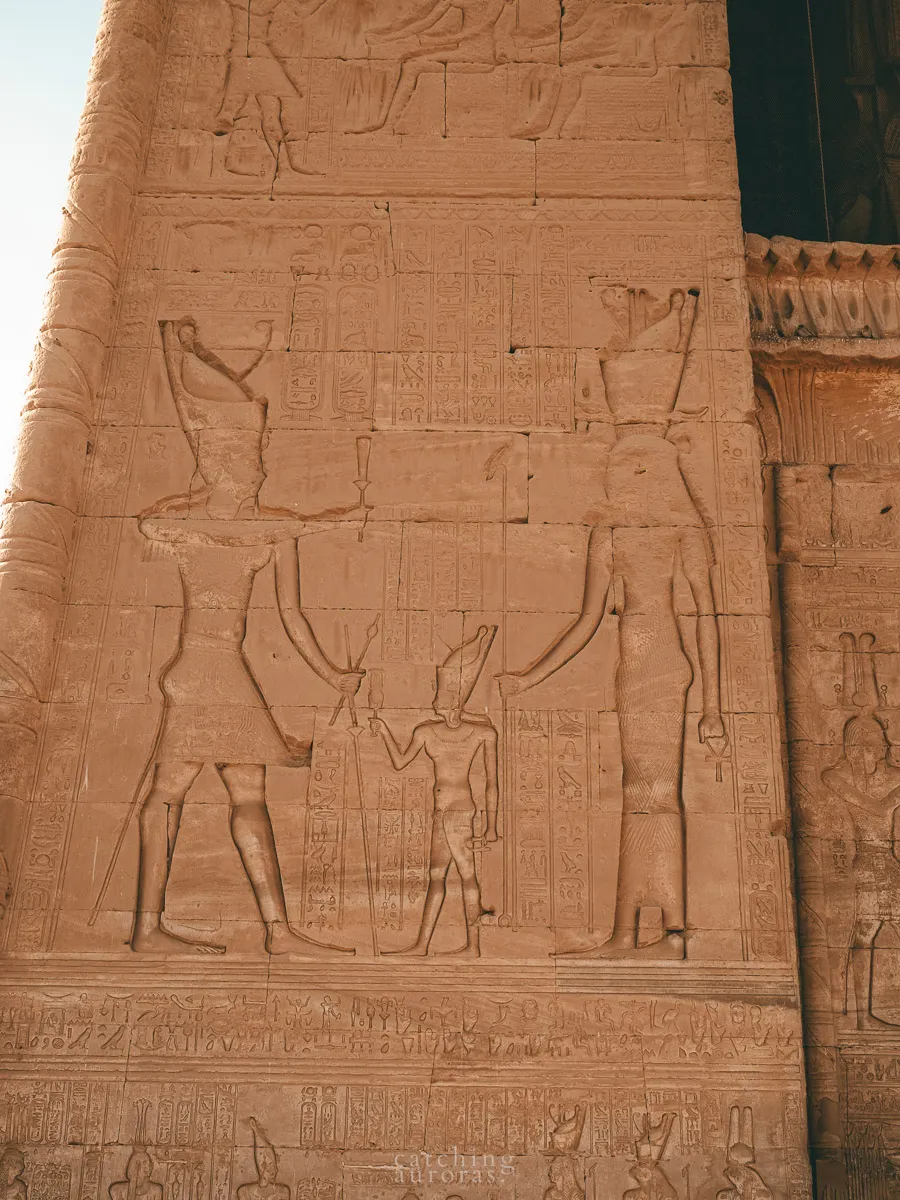
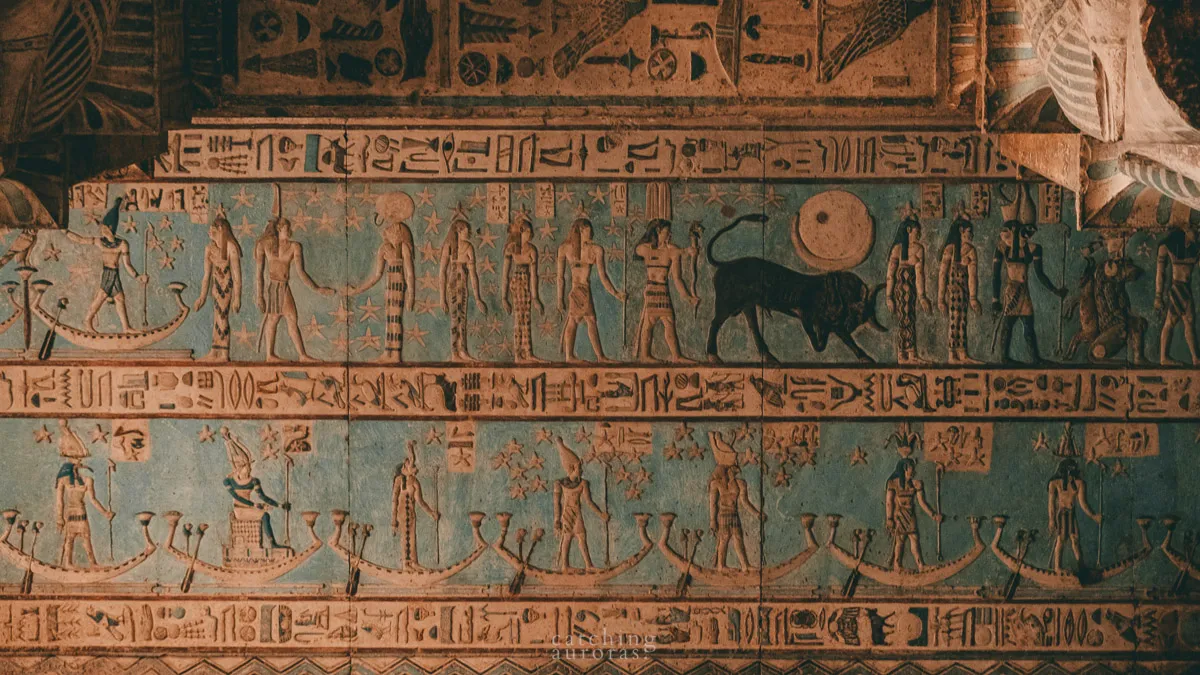
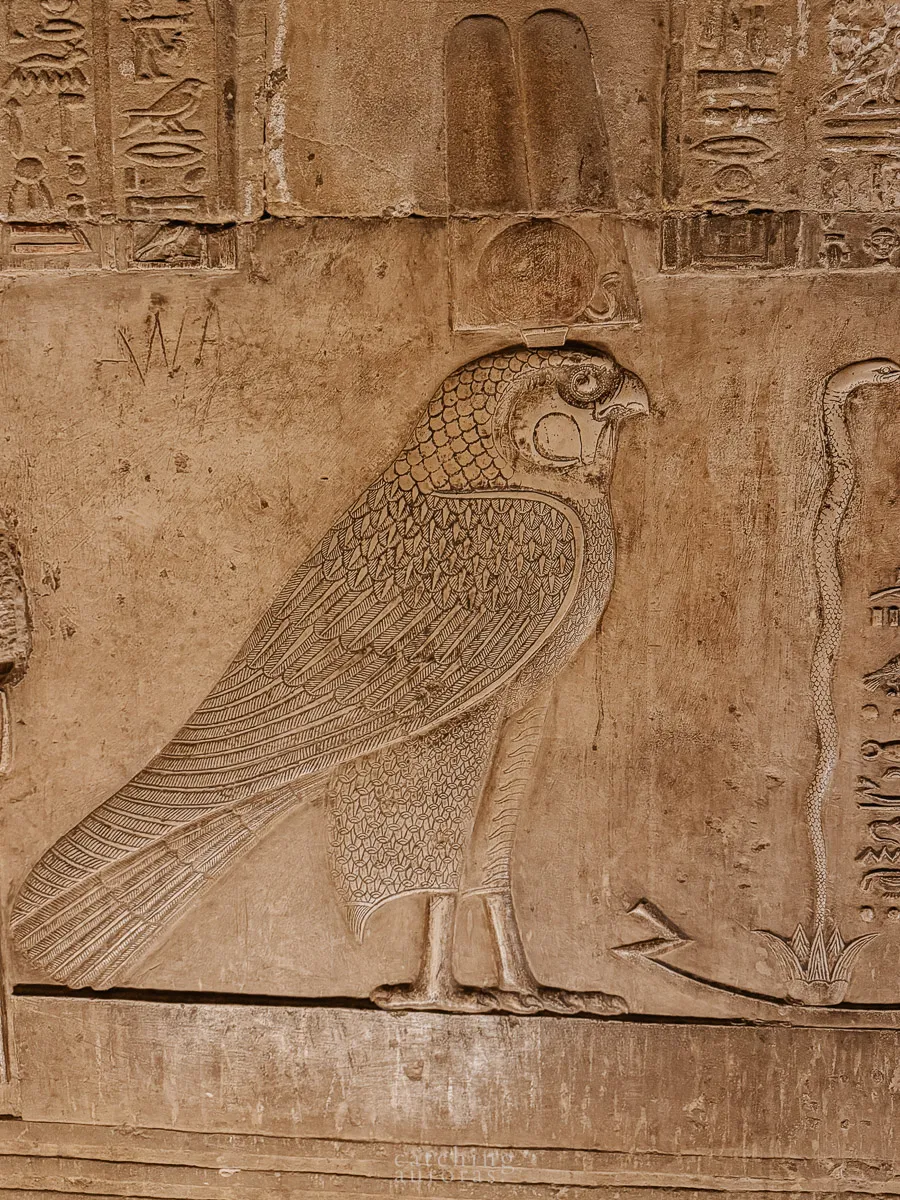
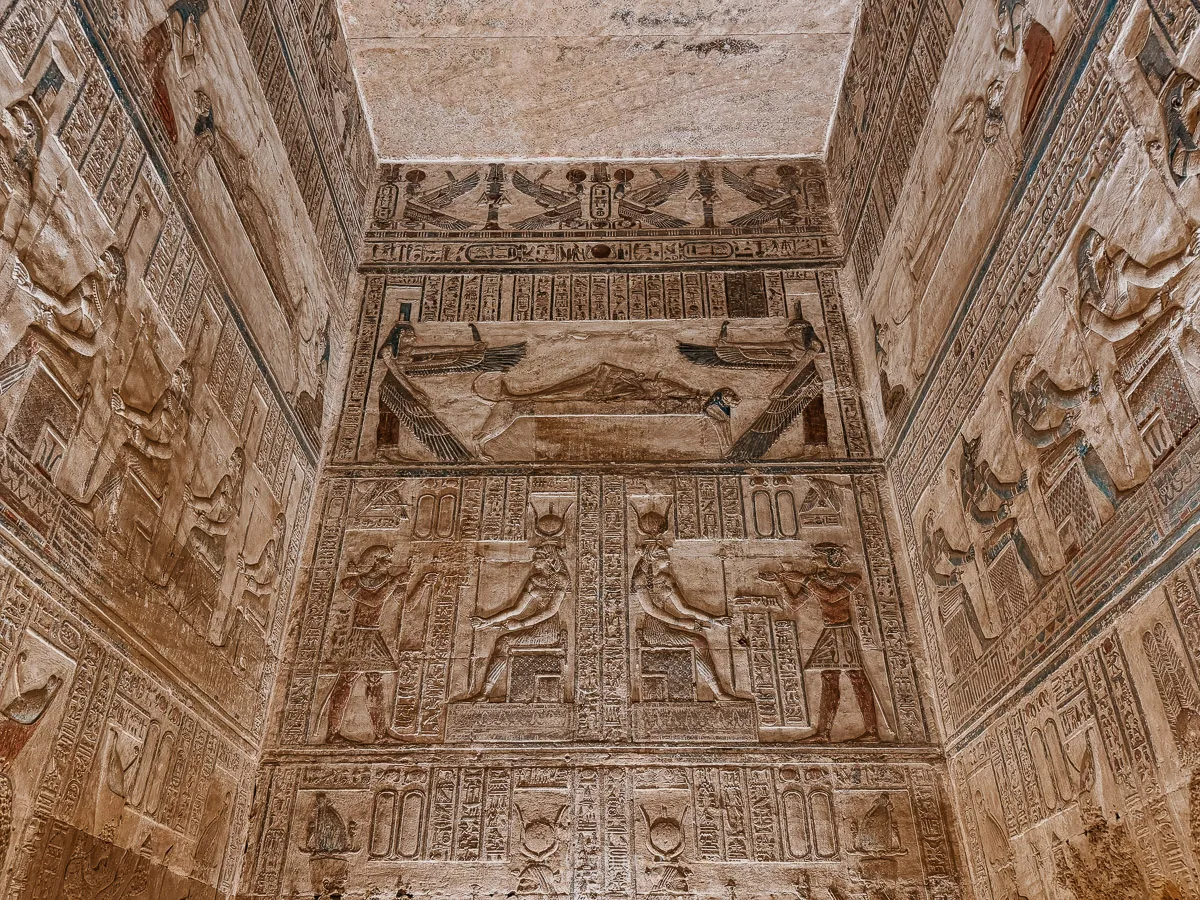
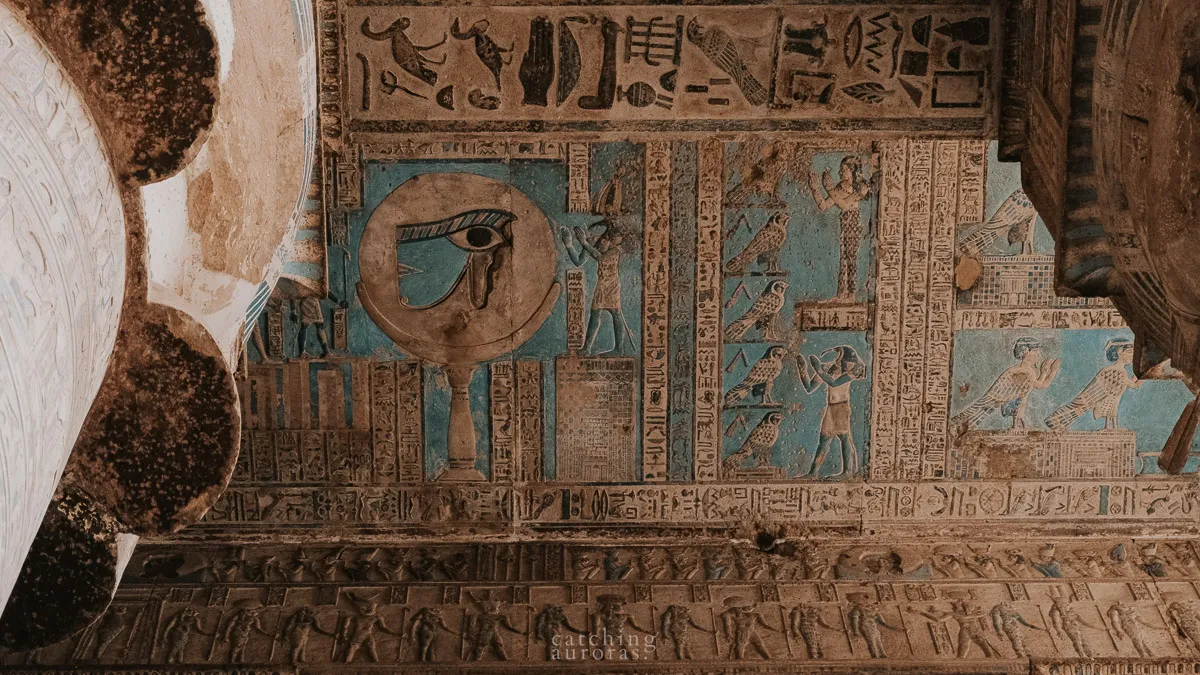
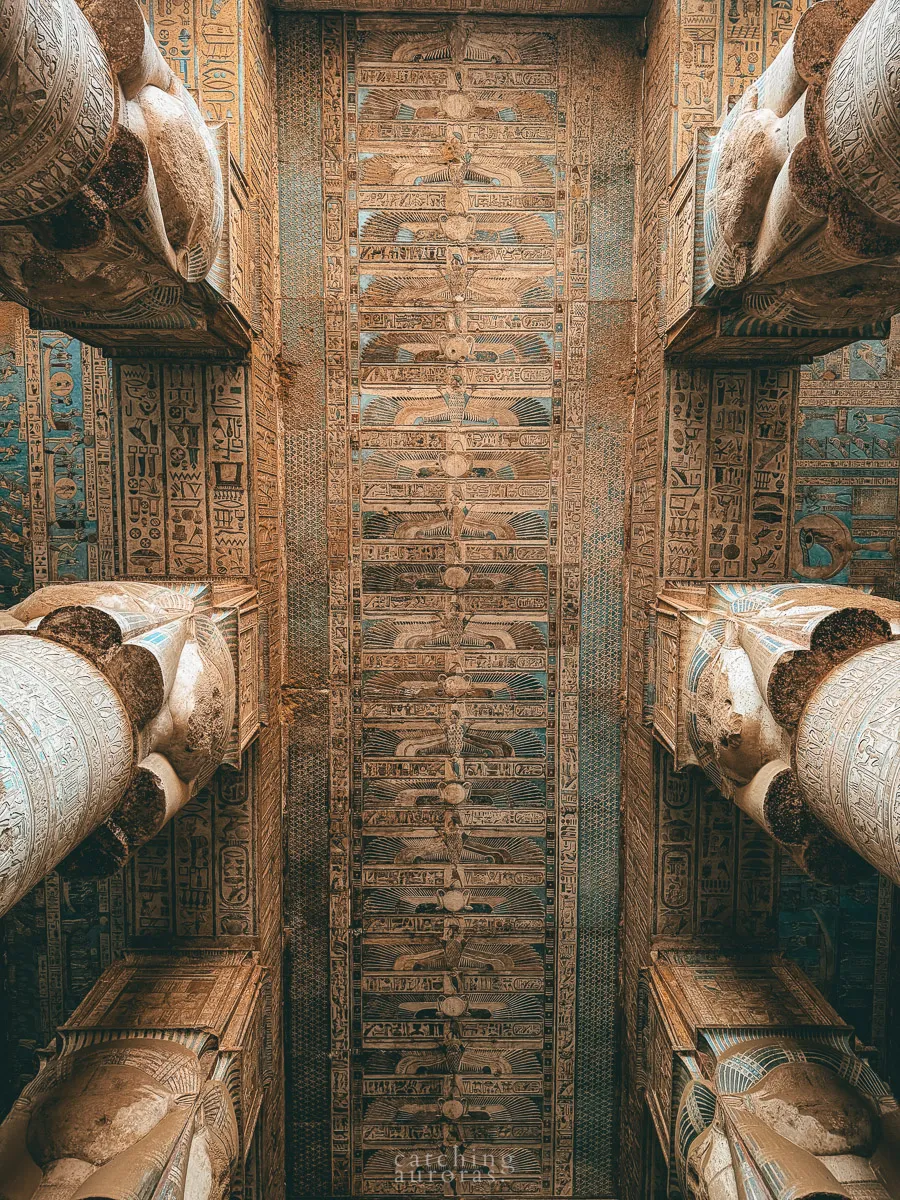
Most Egyptian temples are beautiful skeletons. The shapes are there, the colour is long gone. Dendera still has its colour, which is why it’s deemed to be one of the best preserved temples in Egypt. The carvings are crisp, the ceilings still show deep blues and golden ochres, and there are crypts and side chambers tucked into the walls that most temples simply don’t have.
Highlights you don’t want to skip:
- The Temple of Hathor – the main temple, dedicated to the goddess of love, music, and motherhood
- The astronomical ceiling – the best-preserved temple ceiling in Egypt; the paint actually survived
- The Dendera Zodiac – a circular relief mapping constellations; the original was cut out and shipped to Paris, but there’s a replica in place
- The underground crypts – narrow passageways with some of the most detailed carvings in the whole complex
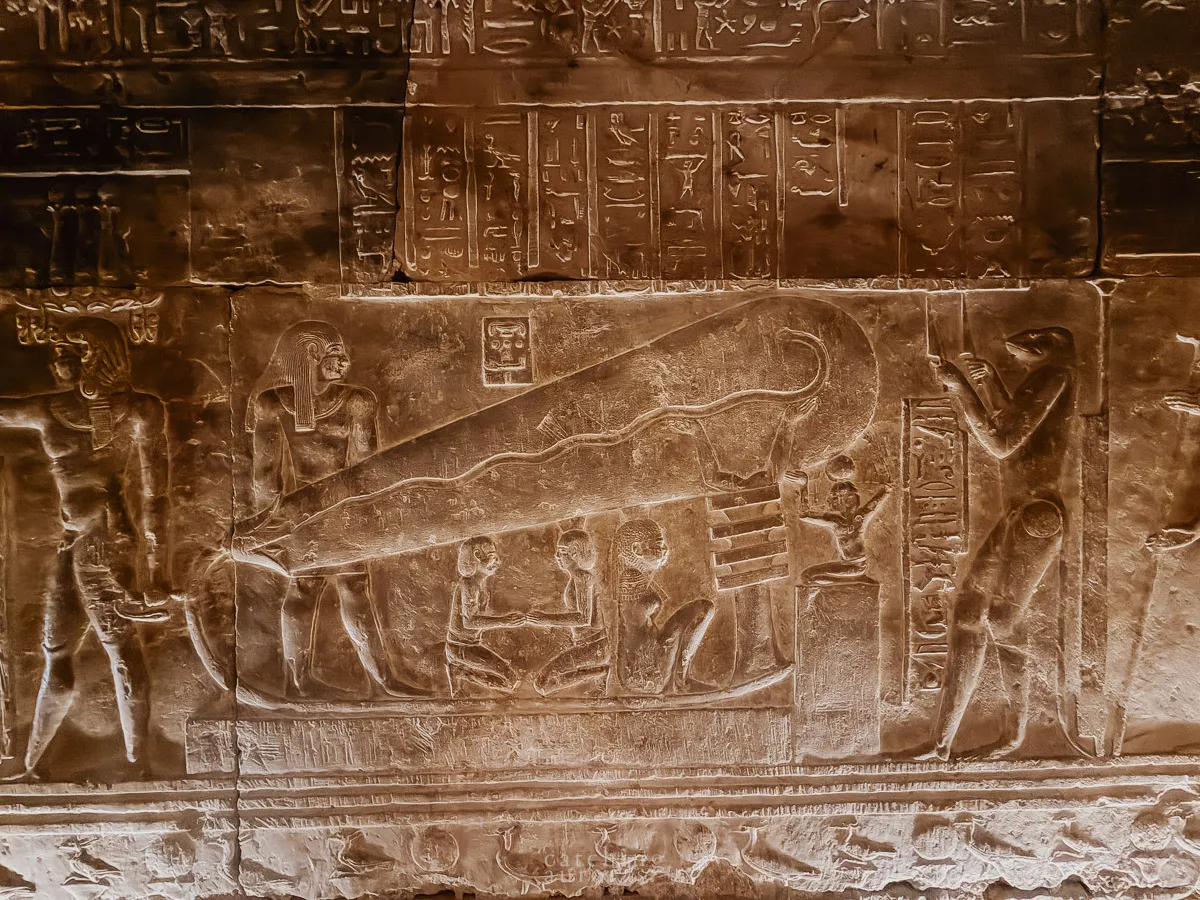
- The “Dendera Light Bulb” relief – a carving that has been generating conspiracy theories for decades
History of Dendera Temple Egypt
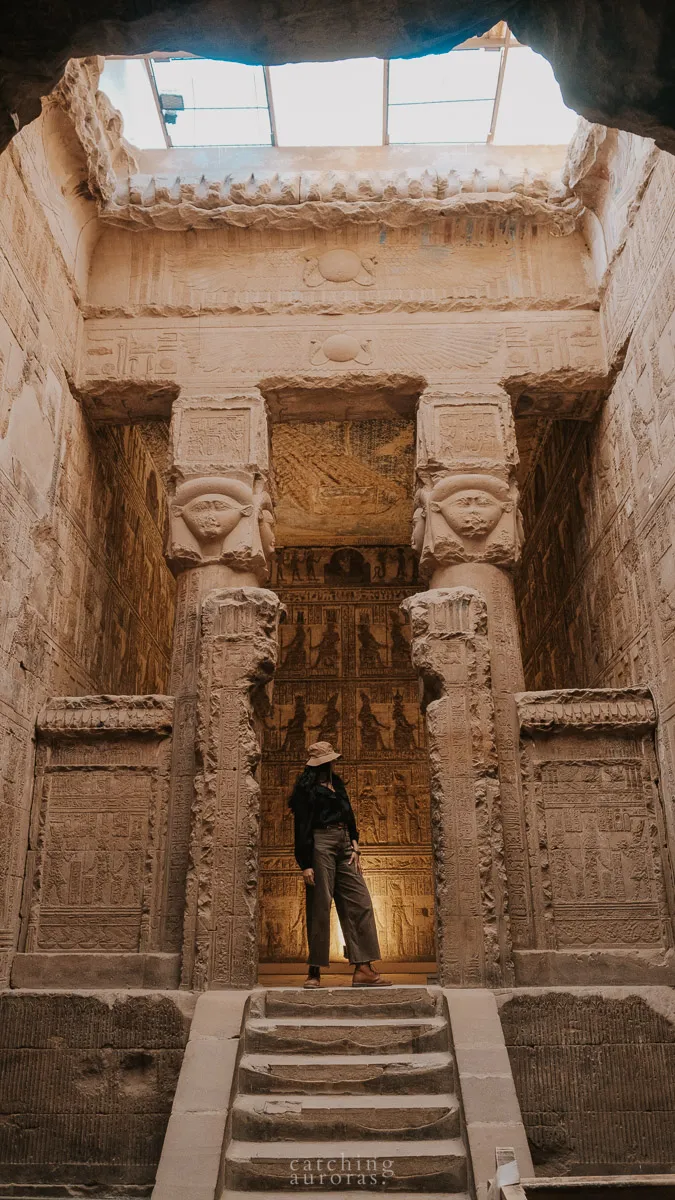
Dendera has been an important religious spot for thousands of years. In Egyptian myth, this is where the goddess Hathor gave birth to Ihy, the child of Horus, which made it her main cult centre and a place of worship going all the way back to predynastic times.
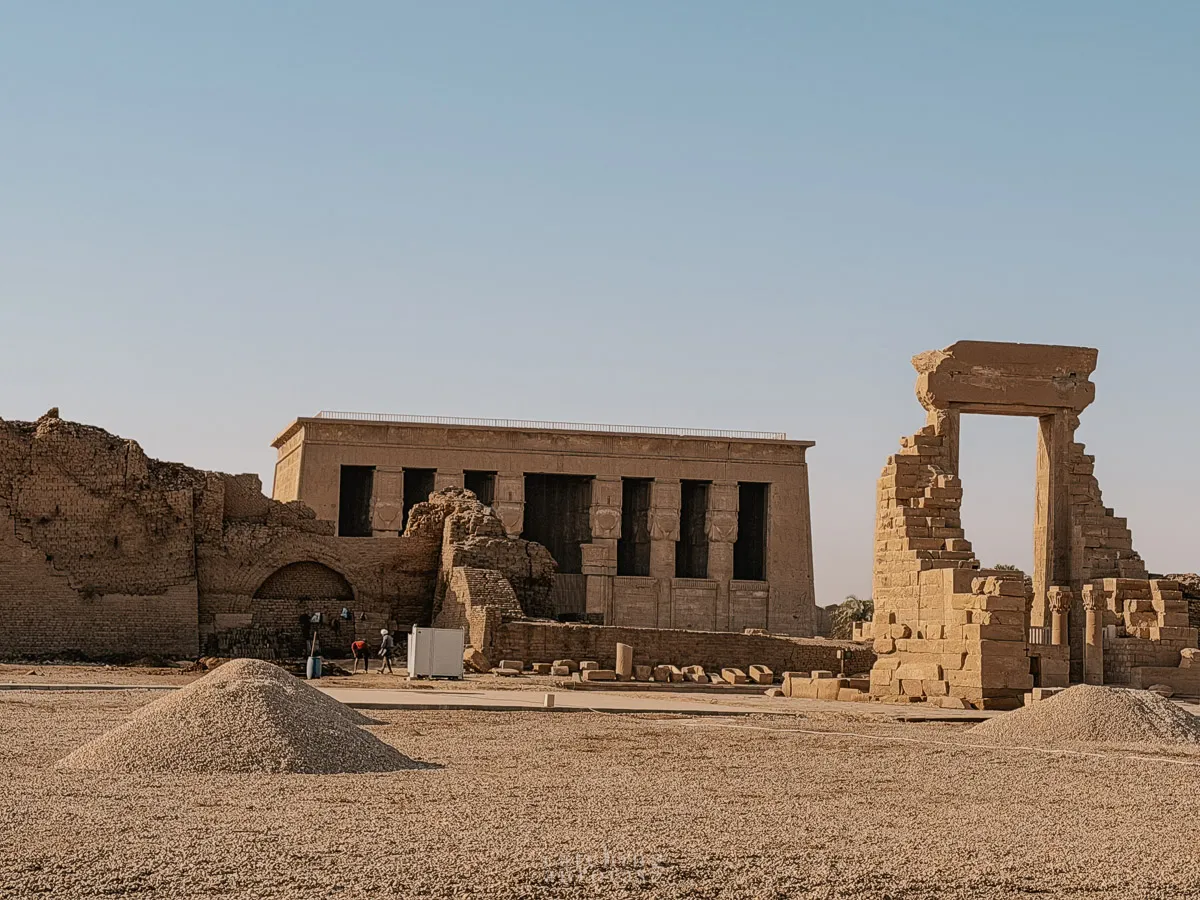
Here’s the part that got me, though: for centuries, most of this complex sat buried under sand. Locals knew it was there, but it wasn’t properly documented until French scholars turned up in the 19th century. And that long burial is exactly why it looks the way it does today. While most temples this old have been bleached blank by the sun, Dendera’s carvings and ceilings stayed protected. The colours survived because nobody could see them.
The complex is big, ringed by a huge mudbrick enclosure wall, and built in layers across different eras – Middle Kingdom, Ptolemaic, and later Roman additions, with traces of even older structures underneath. You’re basically looking at a few thousand years of Egypt stacked in one spot.
The Temple of Hathor: Goddess Symbolism
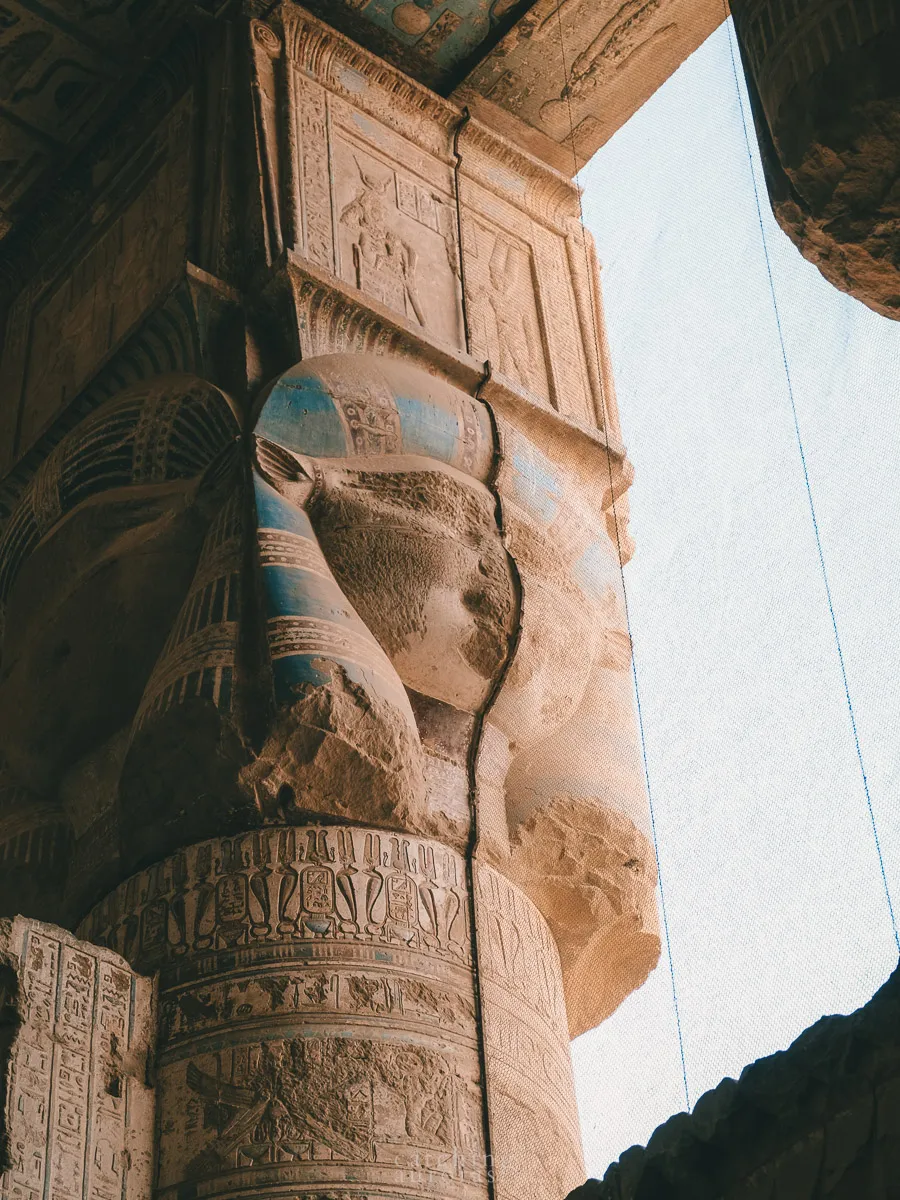
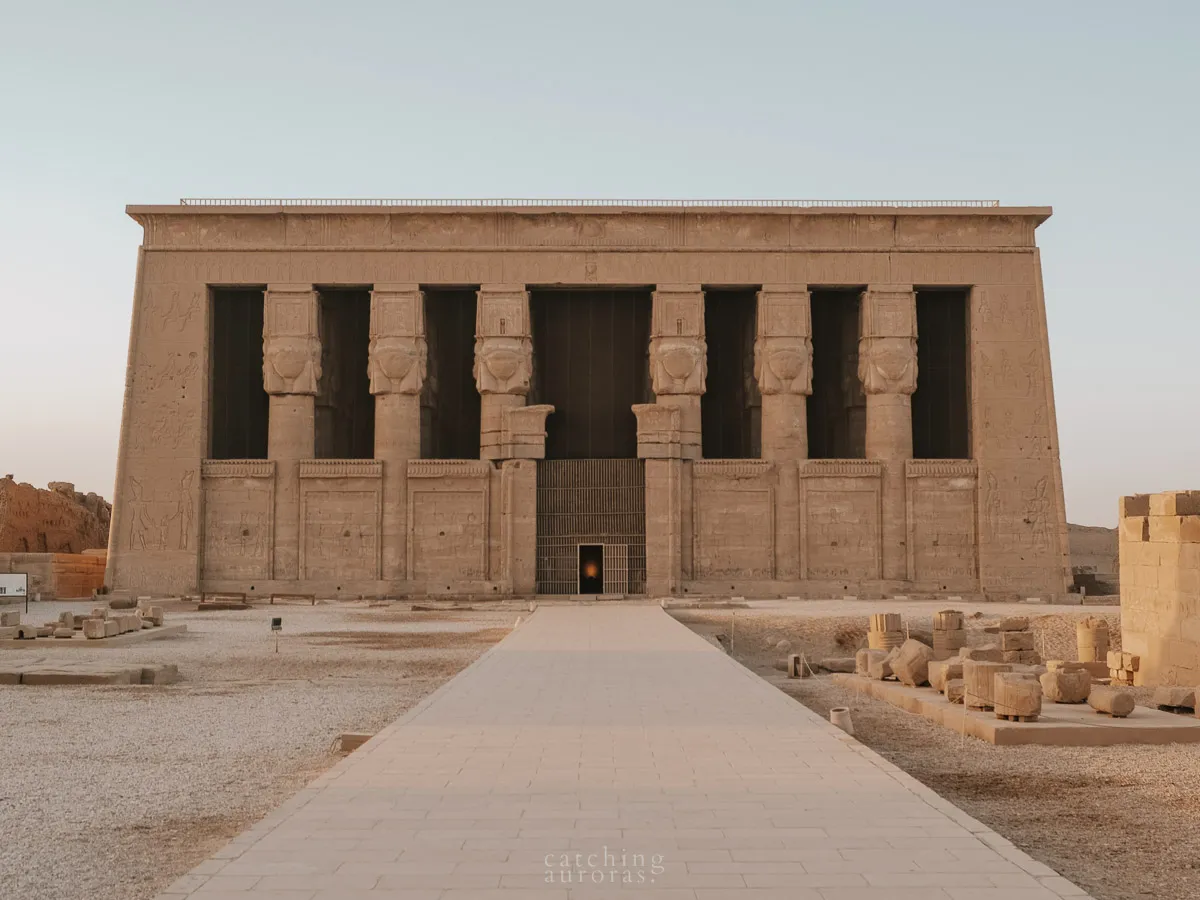
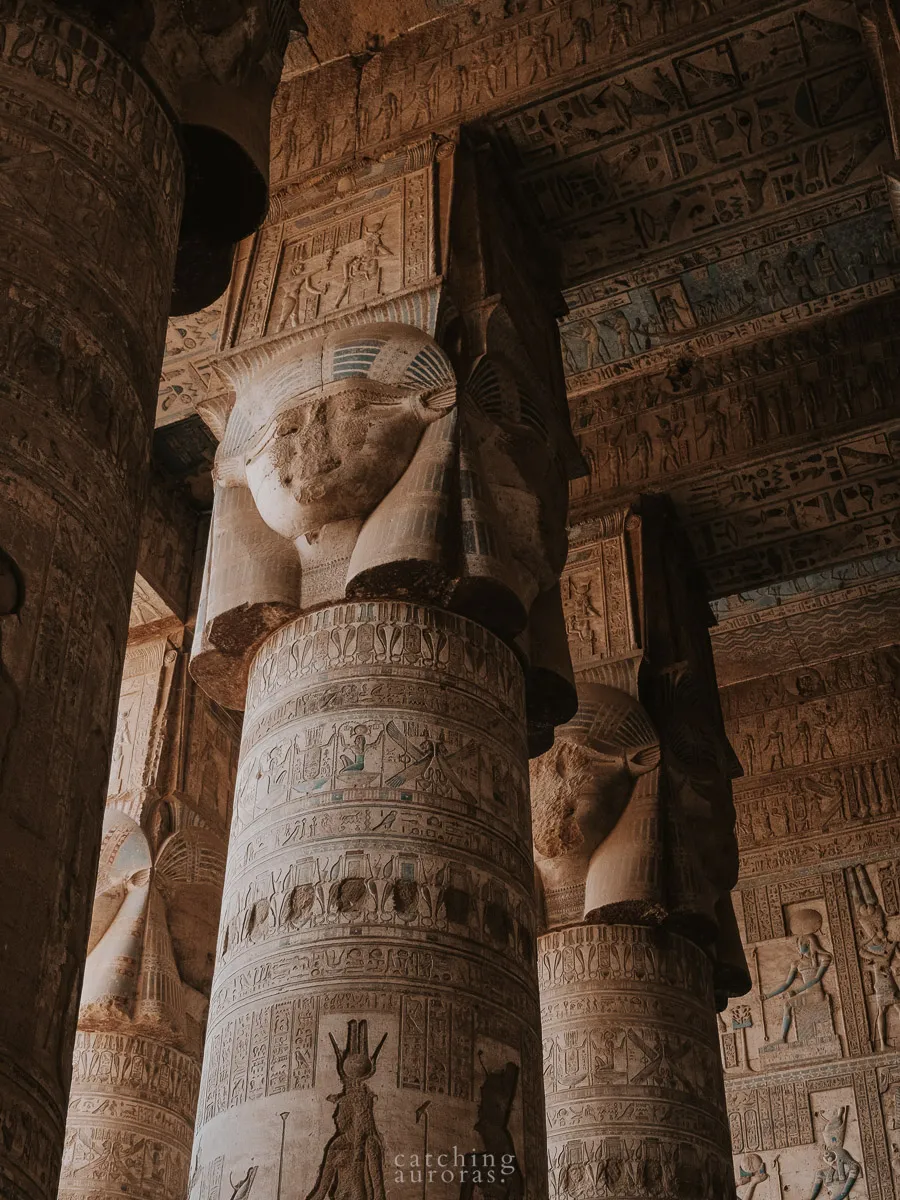
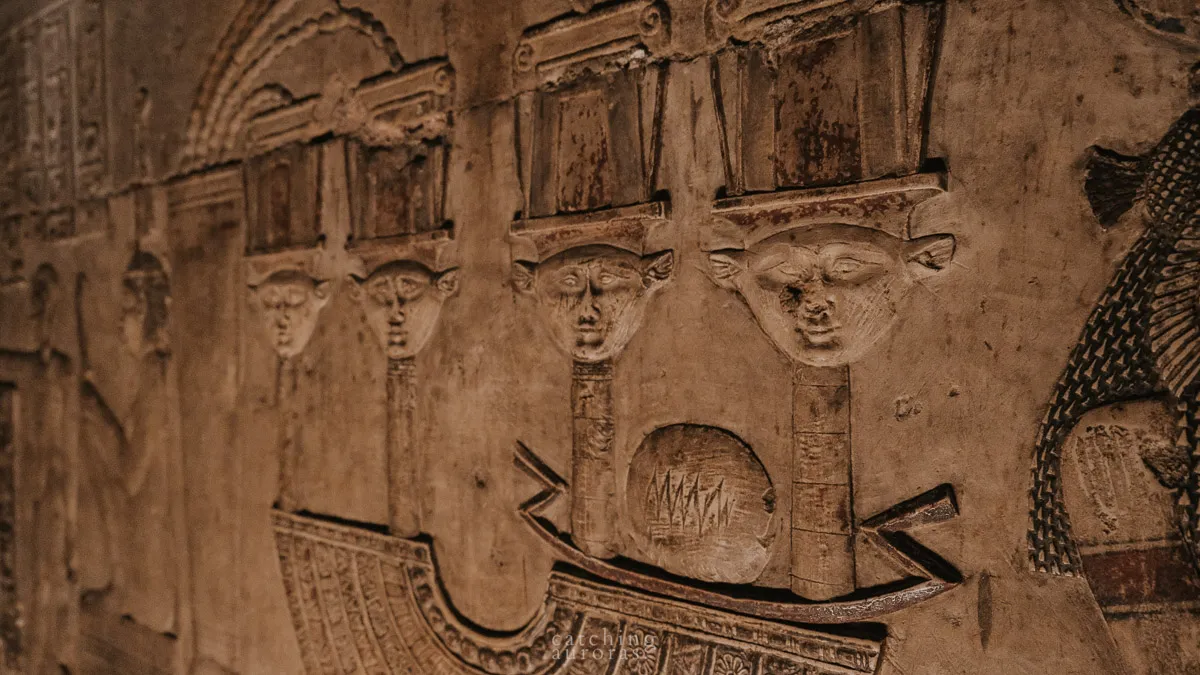
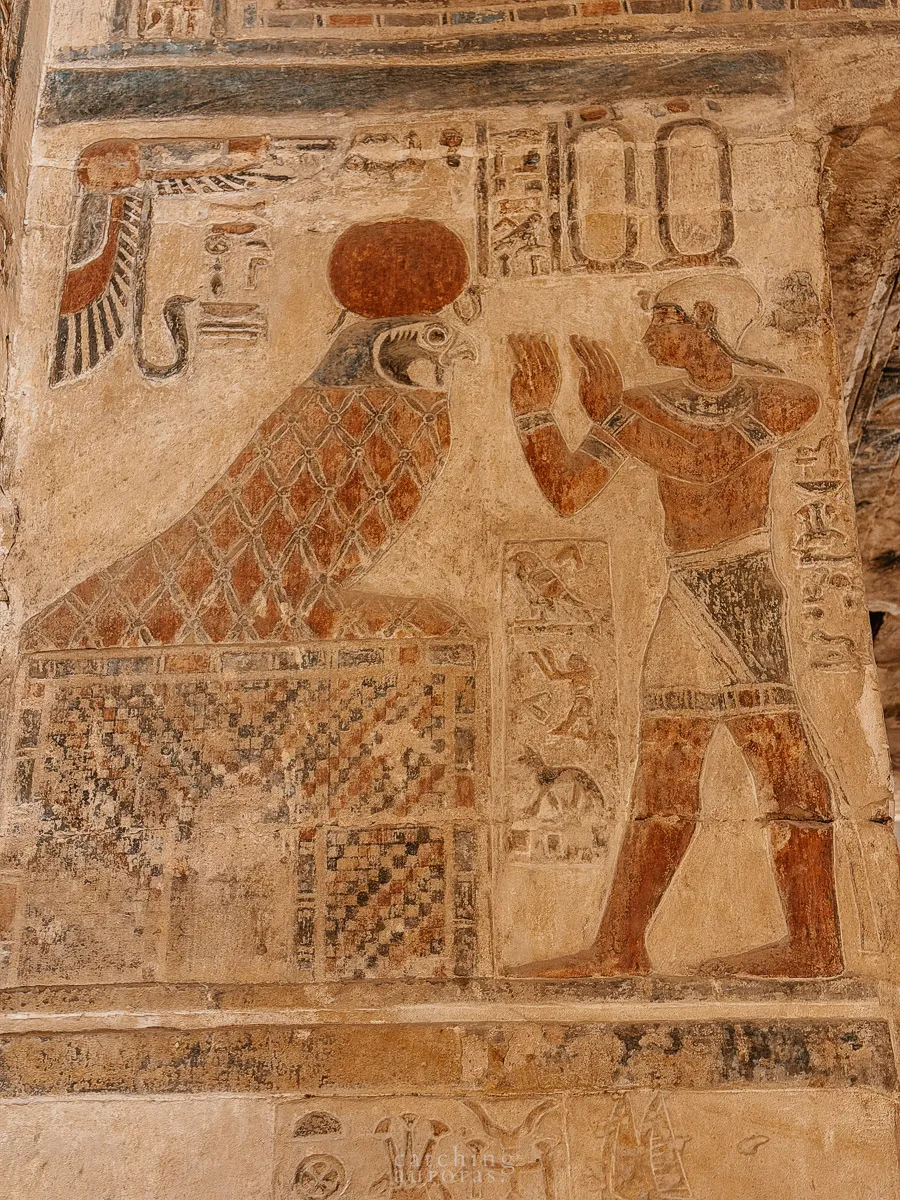
The main structure in the complex is the Temple of Hathor, and you’ll get to know her face very quickly – it’s everywhere. Hathor was the goddess of love, fertility, music and joy, and the divine nurse (sometimes consort) of Horus. In short, she was a big deal.
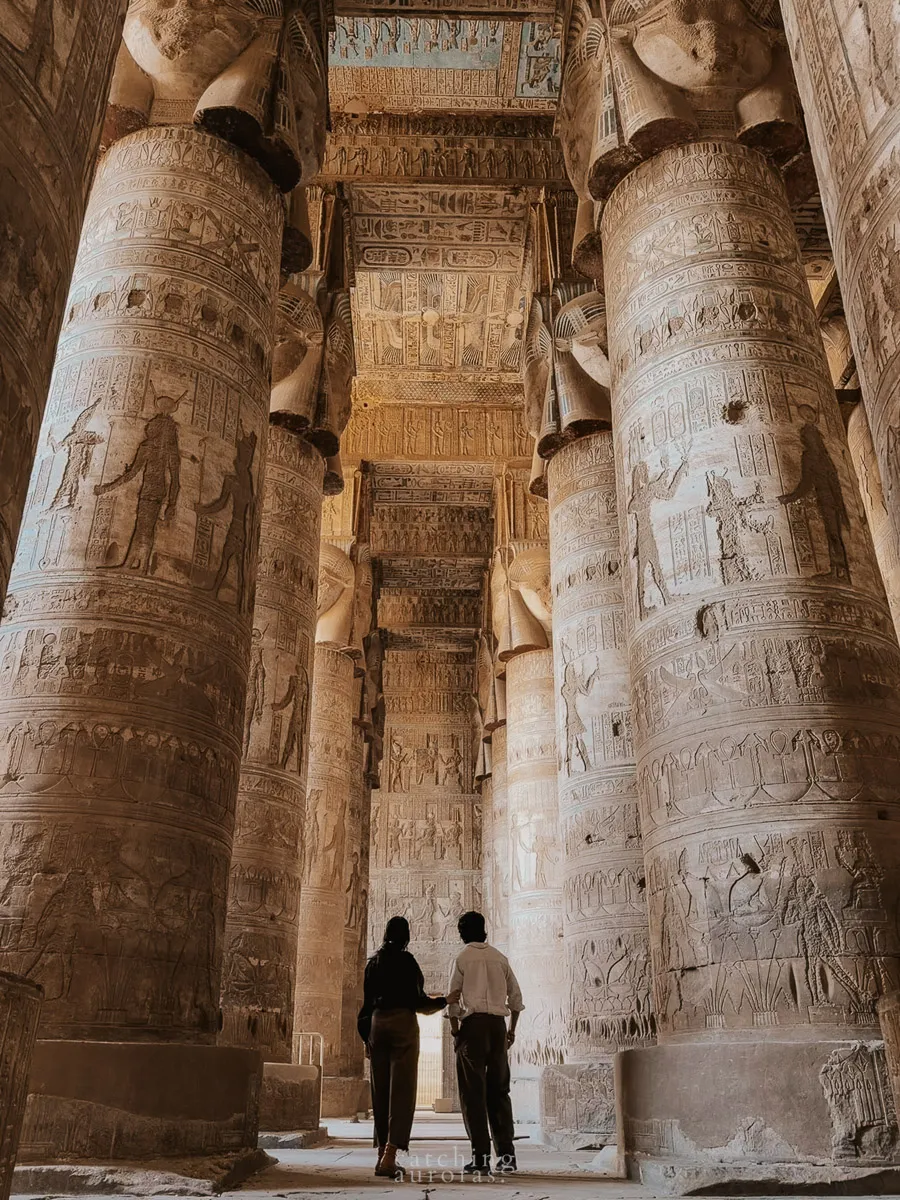
She turns up two ways in the carvings: as a cow, for motherhood and nourishment, or as a woman with cow’s ears. Once you spot the first one at the top of a pillar, you start seeing her everywhere. The same calm face looking down at you from column after column. It’s a little hypnotic.
Two rituals I loved learning about: every year Hathor’s statue made a journey to Edfu to “reunite” with Horus, and at the Egyptian New Year her statue was carried up the western staircase to the rooftop kiosk to be recharged by the rays of the rising sun. Imagine the procession.
The Mysterious Dendera Zodiac
The Dendera Zodiac is a circular stone relief mapping the constellations and ancient Egyptian celestial symbols – one of the only known circular zodiacs from ancient Egypt. How it ended up in Paris is almost as good a story as the relief itself.
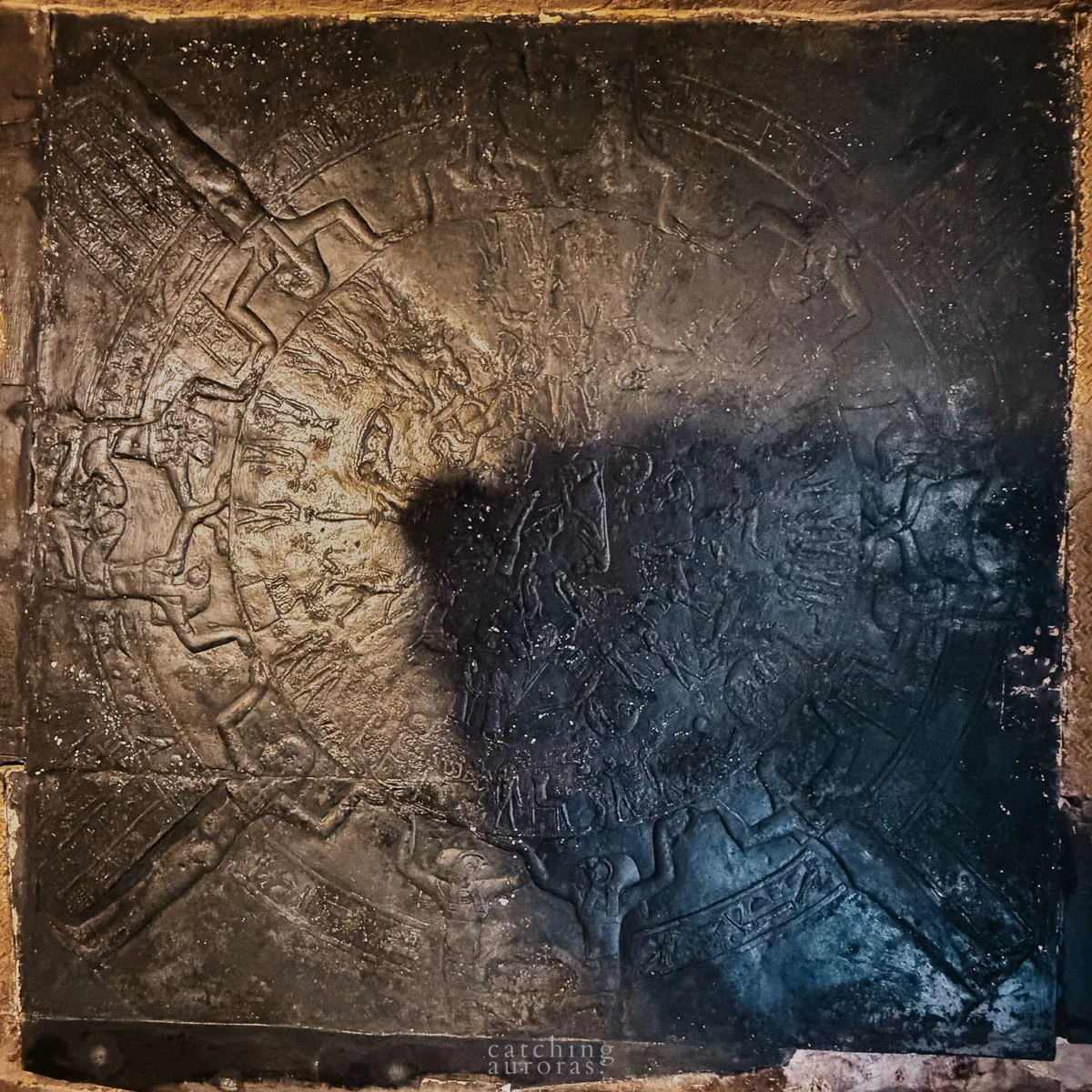
Remember I mentioned earlier that the site was brought to wider Western attention by French scholars in the 19th century? During Napoleon’s expedition to Egypt, the artist Vivant Denon sketched the Zodiac ceiling. When his sketch was published in Europe, it caused a wave of excitement and controversy. Scholars had never seen an ancient Egyptian circular astronomical carving like it.
Then things got ugly.
A French antiquities dealer commissioned a treasure hunter to remove the Zodiac from the temple. The method used would horrify any modern archaeologist: the relief was literally cut out of the ceiling using saws, chisels, jacks, and even gunpowder.
After changing hands several times, the original Dendera Zodiac eventually ended up in the Louvre Museum in Paris, where it is still displayed today.
If you visit Dendera temple in Egypt however, you’ll find a replica mounted in the original location. Climb the narrow staircase to the rooftop chambers and it’s right there above you – a circular relief of the twelve zodiac constellations picked out in fine detail. Even knowing it’s a copy, standing under it in that small chamber, you understand immediately why someone decided it was worth blowing a hole in the ceiling to take it.
The Crypts, Secret Chambers and the Dendera Light Bulb Mystery
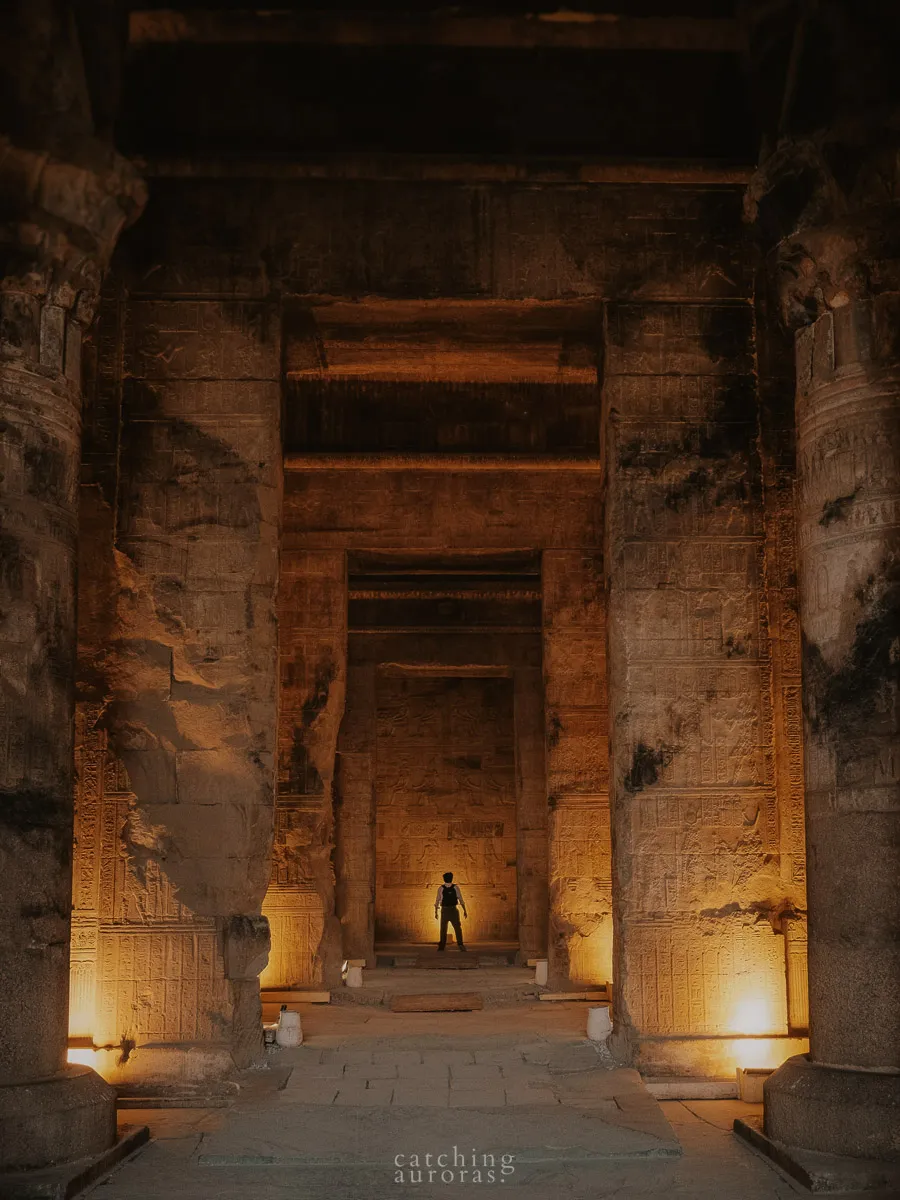
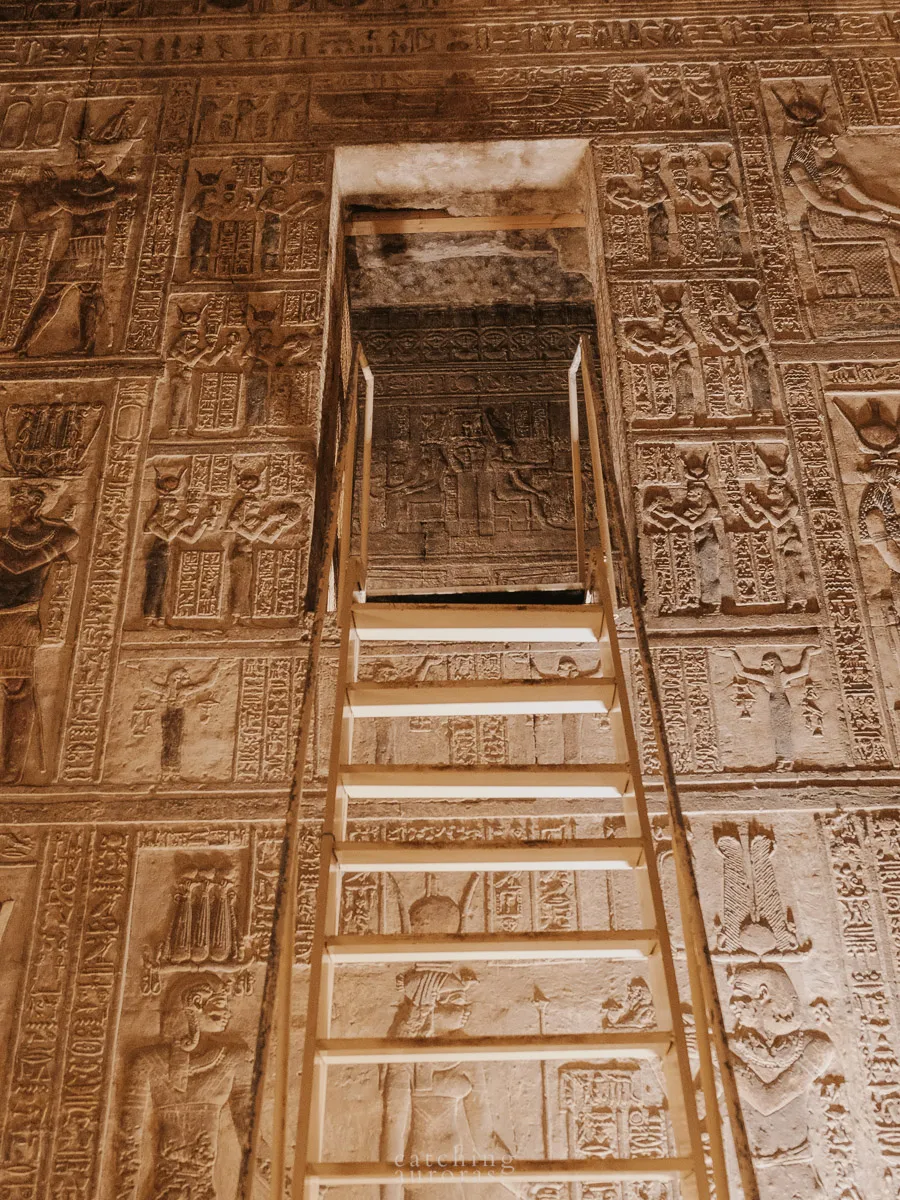
One of the most eerie parts of Dendera Temple Egypt is the network of crypts and secret chambers hidden within the temple walls.
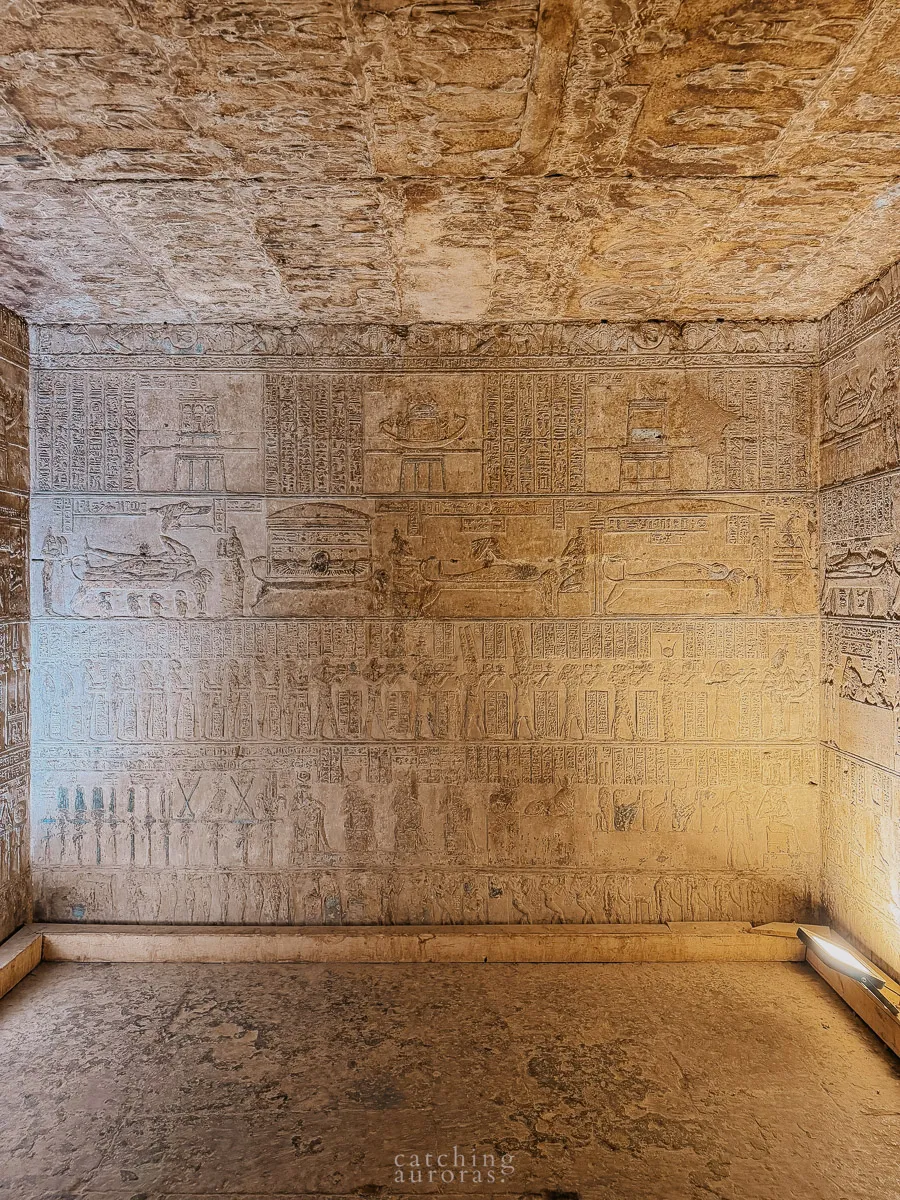
As you explore the temple, you’ll notice several small side rooms. Some have narrow openings and tiny vaulted spaces above them that you can actually climb into (although a few have now been cordoned off). These chambers were likely used for storing sacred objects, statues, and ritual equipment, though the exact purpose of some of these hidden spaces is still debated.
If you want to explore deeper, you can purchase a separate ticket to visit the temple crypts, which costs around 100 EGP. In my opinion, it’s absolutely worth it unless you’re claustrophobic.
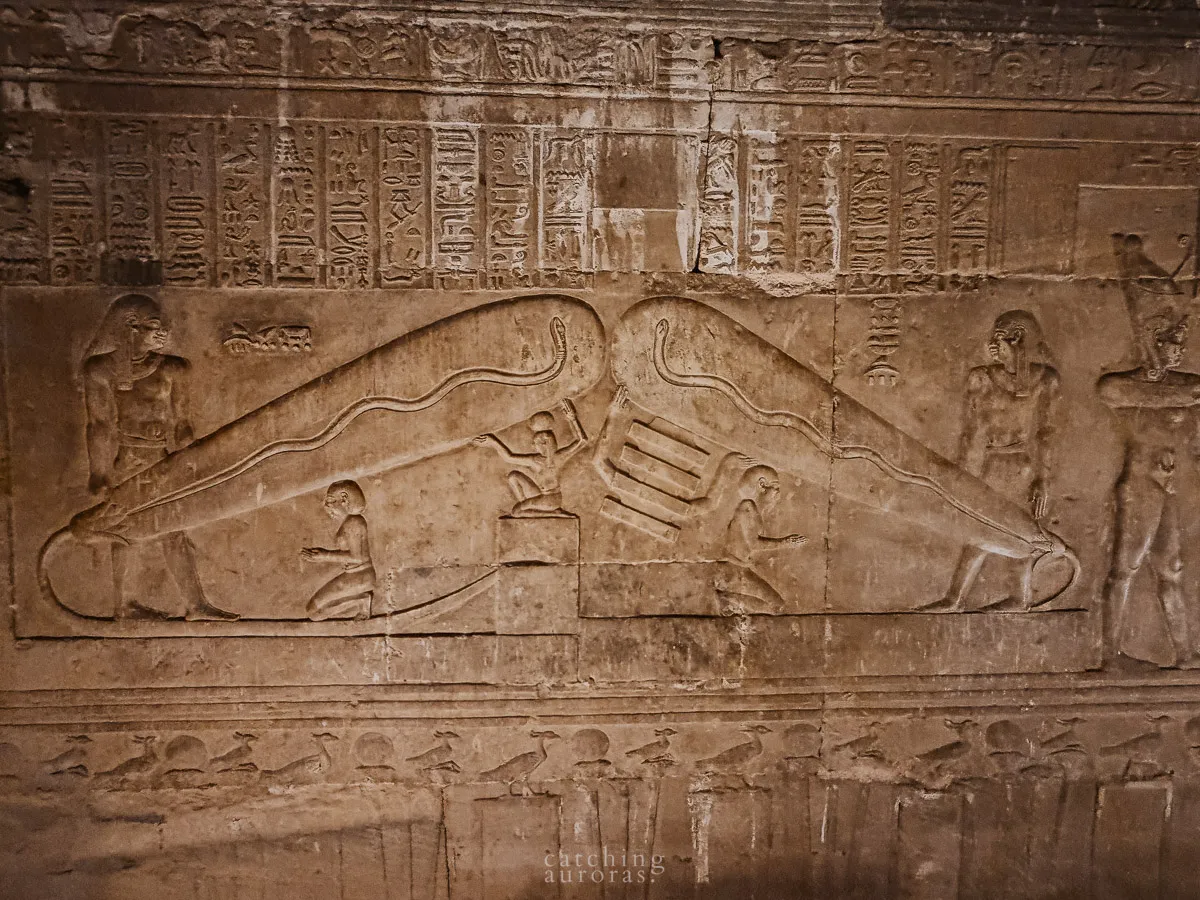
To enter the crypts, you have to climb down and squeeze through a small opening into a narrow stone passageway. The space is tight and dimly lit, but the walls have some of the most detailed carvings in the entire temple complex.
At the end of one of these chambers, you’ll find the famous “Dendera Light Bulb” relief.
The carving has sparked a lot of theories over the years. Some fringe theorists claim it represents an ancient electric light bulb (I mean, it does look like one, doesn’t it?). Egyptologists, however, interpret the scene very differently. According to mainstream interpretations, the carving actually represents a cosmic creation myth, where the serpent emerging from a lotus symbolizes the birth of the universe.
Whatever interpretation you believe, seeing the carving inside the narrow crypt makes the experience feel even more mysterious and is well worth squeezing through a claustrophobic entrance.
Architecture Highlights Inside the Temple
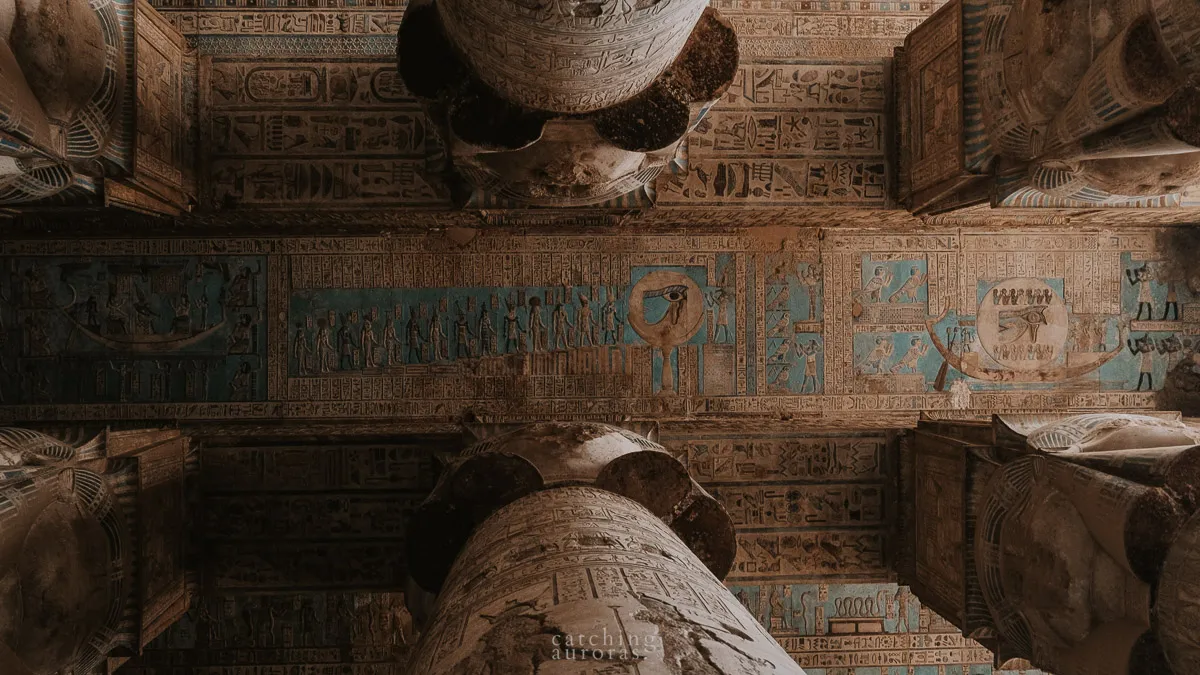
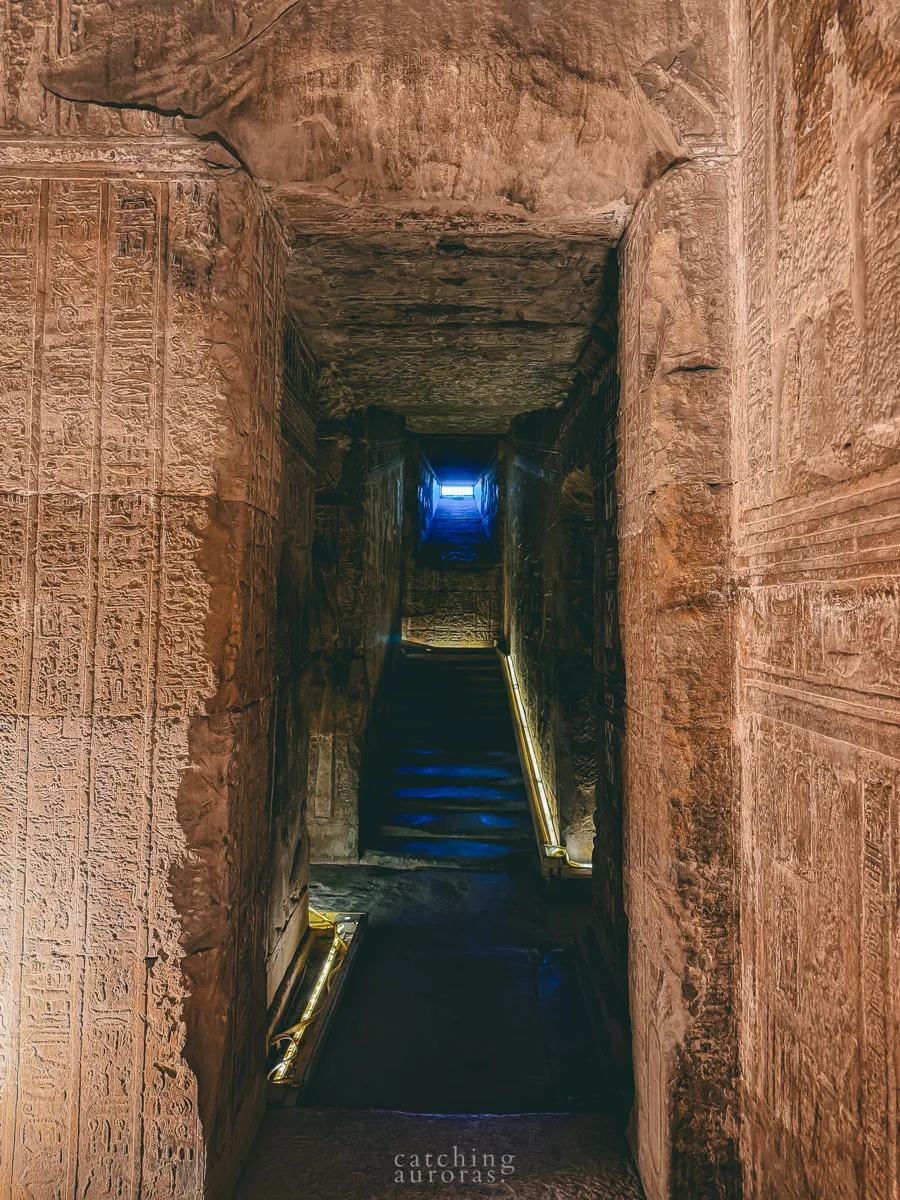
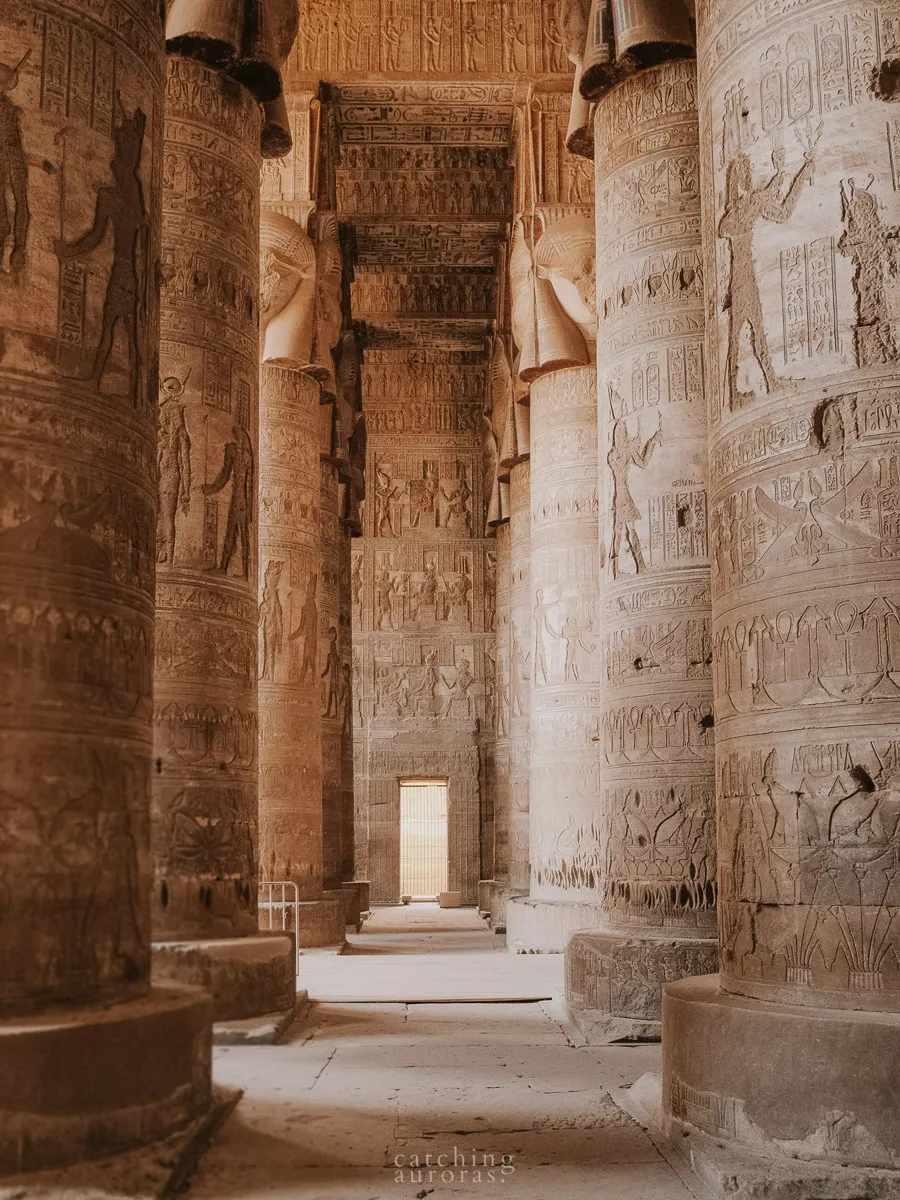
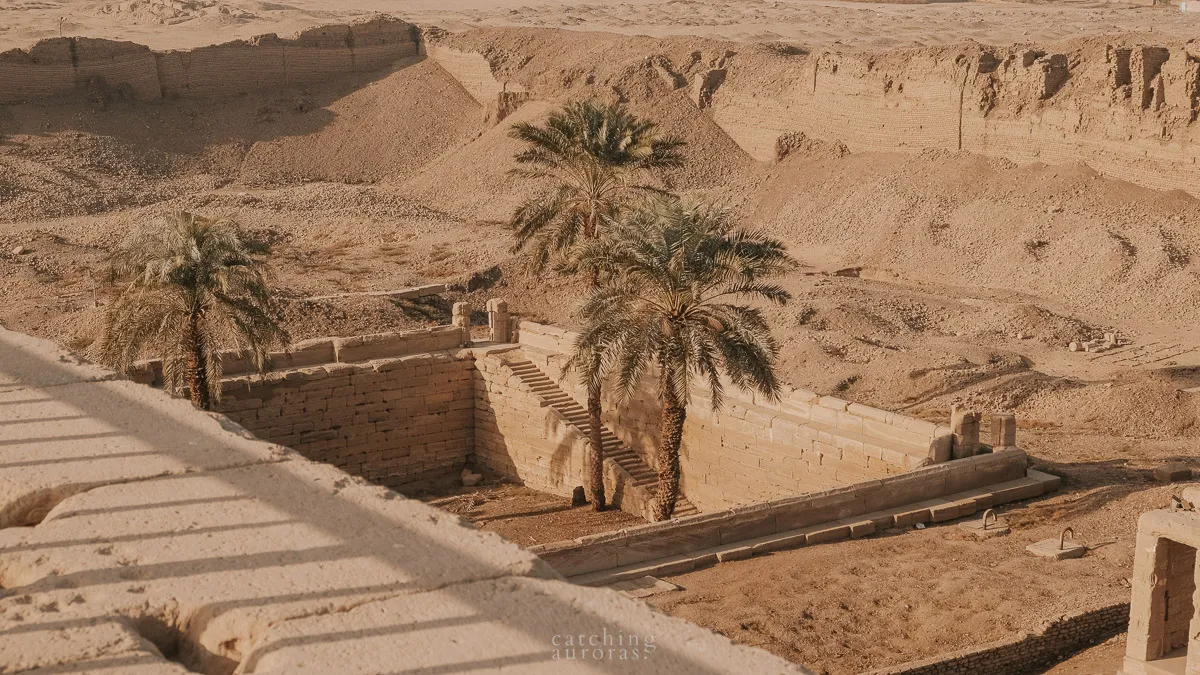
The Dendera Temple complex has details tucked into every corner. As you explore the temple, here are a few things worth tracking down:
- The hypostyle hall with 24 towering columns, each topped with the iconic face of Hathor
- The sacred lake located just outside the temple, once used for purification rituals
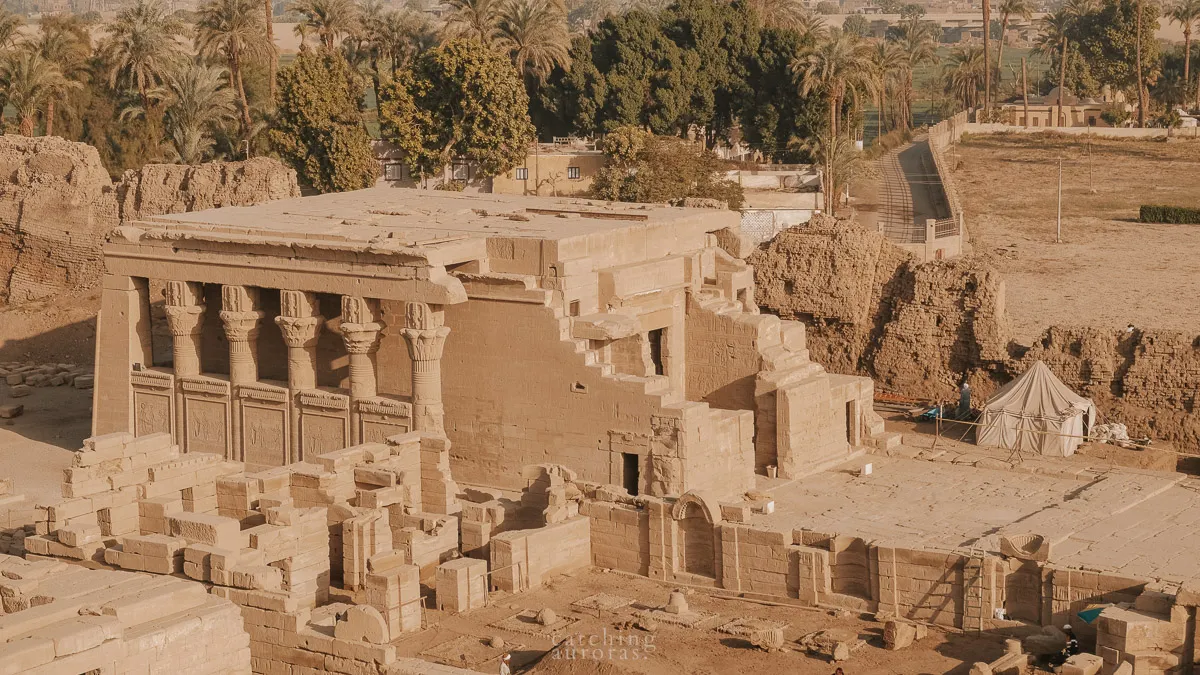
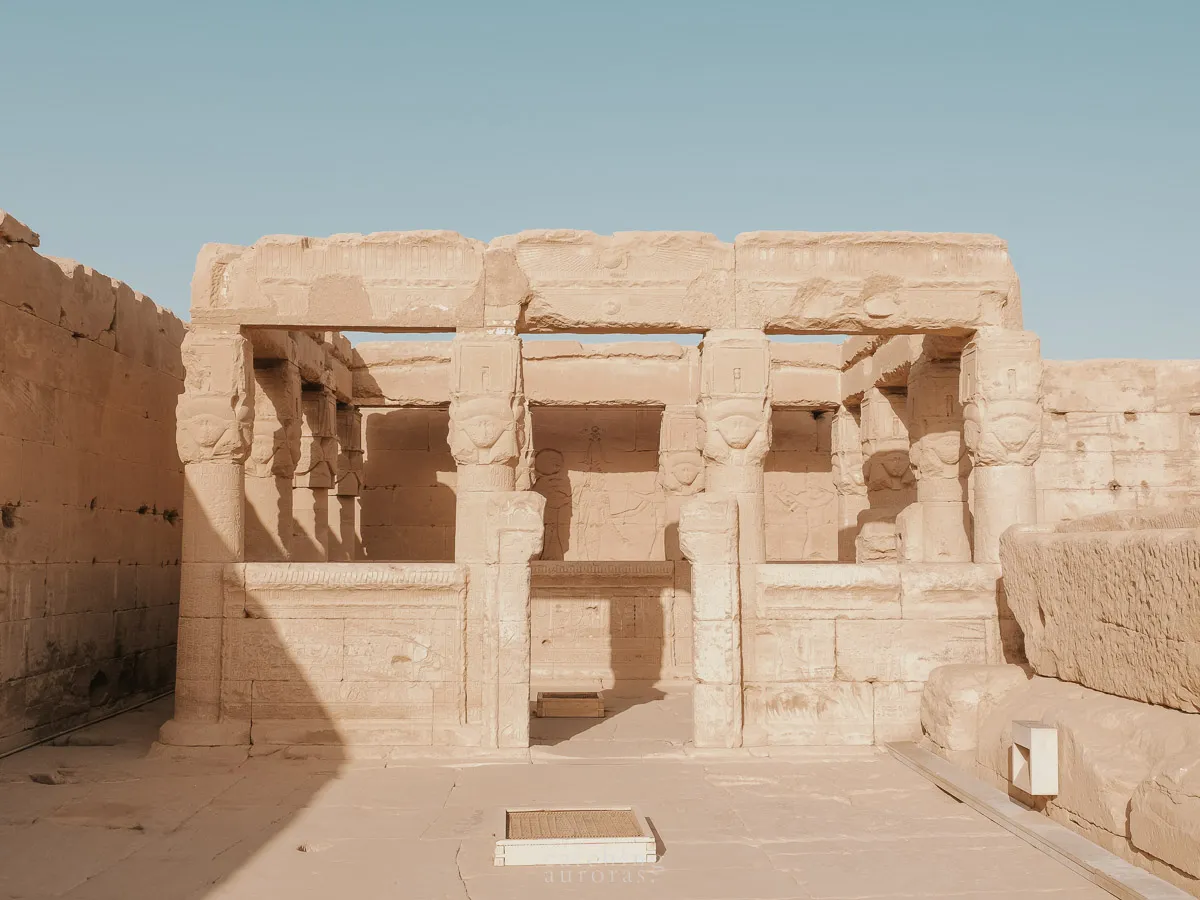
- The mammisi (birth house), a small temple dedicated to the birth of Ihy, the child of Hathor
- The rooftop, where you can walk around and enjoy views of the surrounding Nile Valley. Notice the outer brick wall and appreciate the sheer size of the complex while you are here.
- The Zodiac replica, located in a chamber on the temple roof
- The “melting” staircases leading to the rooftop, worn so smooth by centuries of foot traffic they look liquid
- The underground crypts, where you can see the famous Dendera Light Bulb relief
The carvings and the ceilings – blues, greens, ochres still holding on after 2,000 years – make Dendera one of the most photographed temples in Egypt.
How to Visit Dendera Temple from Luxor
Dendera is about 70 km from Luxor, roughly 1 to 1.5 hours by road. Most people do it as a half-day trip. If you combine it with Abydos, it would be a full day trip.
Here are the most common ways to visit Dendera Temple from Luxor:
Private Car or Taxi
- About 1–1.5 hours each way
- Most flexible – you set the timing, you leave early
- Can combine with Abydos if you want a full day
- Negotiate the full return price in advance, confirm whether waiting time is included
Guided Tour
- Many Luxor tours include both Dendera and Abydos
- Covers transport and entrance logistics
- Worth it if you want historical context while walking through
Since we like early starts and didn’t need a guide, we booked a private cab the night before. At 6 AM with no traffic, it took under 50 minutes to reach Dendera. We paid around EGP 2,000 for the cab (+ EGP 200 given as baksheesh to the driver).
Entrance Fees & Opening Hours (2026)
Dendera Temple Egypt is open daily from 7:00 AM to 4:00 PM.
As of 2026, the entrance fees are:
| Ticket | Price (2026) | What it covers |
|---|---|---|
| Main entry (foreign) | 300 EGP | The full temple complex |
| Main entry (student) | 150 EGP | With valid student ID |
| Crypts / Catacombs | +100 EGP | Underground chamber + Dendera Light Bulb relief |
| Panorama / Rooftop | +100 EGP | Rooftop panoramic access |
Note: you can see the Dendera Zodiac replica without the rooftop ticket. Tickets can be pre-booked at https://egymonuments.com/details/DandarahTemple.
Is Dendera Temple Worth Visiting?
Absolutely.
Compared to the crowd at Karnak or Luxor Temple, Dendera feels calm and almost private – you get the ceilings, the crypts, the rooftop and the Zodiac without elbowing through a tour group. If you’re the type who’d happily lie flat on a temple floor staring at a painted ceiling for an hour – and by now you’ve probably guessed I am – Dendera will quietly ruin other temples for you. Cab drama and 6 AM start included, it was one of the most memorable temple visits of our whole Egypt trip.
Best Time to Visit Dendera Temple
The best time to visit Dendera Temple Egypt is during the cooler months, when exploring the temple complex is much more comfortable.
Best months to visit – October to April. Upper Egypt in the summer is punishing – I’ve heard people describe May in Luxor as standing inside an oven, and I believe them.
Within those months, early morning is best. Fewer people, cooler air, and the light through the temple entrance hits the carvings differently than midday.
We left Luxor at 6 AM and had most of the temple to ourselves for the first hour. By the time the tour groups started arriving around 9, we were already heading out.
If you’re visiting during the summer months (May to September), try to avoid the midday heat, as temperatures in Upper Egypt can become extremely intense.
Can You Visit Dendera and Abydos in One Day?
Yes, it’s possible to visit Dendera and Abydos in one day from Luxor, but it does make for a fairly long day.
Abydos is about 120 km north of Dendera – another 1.5 to 2 hours of driving between the two sites. If you’re doing both from Luxor, you’re looking at roughly 7 to 8 hours total: 3 hours of driving, 2 hours at Dendera, 2 hours at Abydos, plus any stops.
We ended up skipping Abydos because we couldn’t find a driver we trusted at a price that made sense. If I go back to Egypt, that’s first on the list.
If you do want both: leave by 6 AM, do Dendera first (it’s closer), then push on to Abydos. Start any later and you’ll be at the second temple in the worst of the afternoon heat.
Final Thoughts on Visiting Dendera Temple
After all the cab drama and our reluctance to even leave the hotel that morning, visiting the Dendera Temple in Egypt turned out to be memorable.
Unlike the crowded temples in Luxor, Dendera felt calm, mysterious, and incredibly well preserved. Walking through the dark crypt chambers, climbing up to the rooftop, and seeing the ceilings inside the Temple of Hathor made the effort completely worth it. Honestly, it was the perfect way to end our Egypt trip.
Getting there from Luxor is a hassle, yes. Taxis are a negotiation, the prices are irritating, and you’ll probably overpay regardless. But if you’re already in Luxor, skipping Dendera would be a mistake.
And if Egypt hasn’t completely drained your travel spirit by this point in your journey, you can even combine it with Abydos, another incredible temple complex nearby.
A Note on DIY Travel in Egypt
If you’re wondering whether you can travel around Egypt independently, without a guide or a tour package, the answer is yes. You absolutely can.
And you can do it on a budget too.
During our trip, we travelled across Cairo, Aswan, Luxor, Abu Simbel, and Dendera by arranging private taxis, taking shared minibuses, and contacting hotels directly. It does take a bit more effort than travelling somewhere extremely organized like Japan, but it’s far from impossible.
Don’t let the clickbait videos online convince you otherwise. They nearly made me cancel my trip twice.
We travel frequently and usually try to do it on a reasonable budget. So naturally, I found myself questioning why some taxi drivers were quoting over $150 USD for relatively short trips – whether it was a half-day visit or a full-day outing. Considering that fuel prices in Egypt are significantly lower than in many other countries (including India), those prices didn’t always make sense to us.
Another thing we noticed is that many drivers quote prices directly in US dollars, even though it’s not the local currency for either them or us. Sometimes the expectation is that travellers will simply accept the price because it’s considered “cheap” by Western standards.
At one point, someone on TripAdvisor even suggested that if I wasn’t willing to pay whatever price a driver asked for, maybe I shouldn’t visit places like Dendera at all.
But honestly, that’s not how we see travel.
With patience, planning and a willingness to negotiate, you can do Egypt independently and have an excellent trip. It just requires more tolerance for friction than most destinations.

1 comment
Nick
Hi,
I am going to Dendara today from Luxor. You did not say the negotiated taxi fare you paid. That would have been useful.
Thanks for the rest of the article.
Kind regards